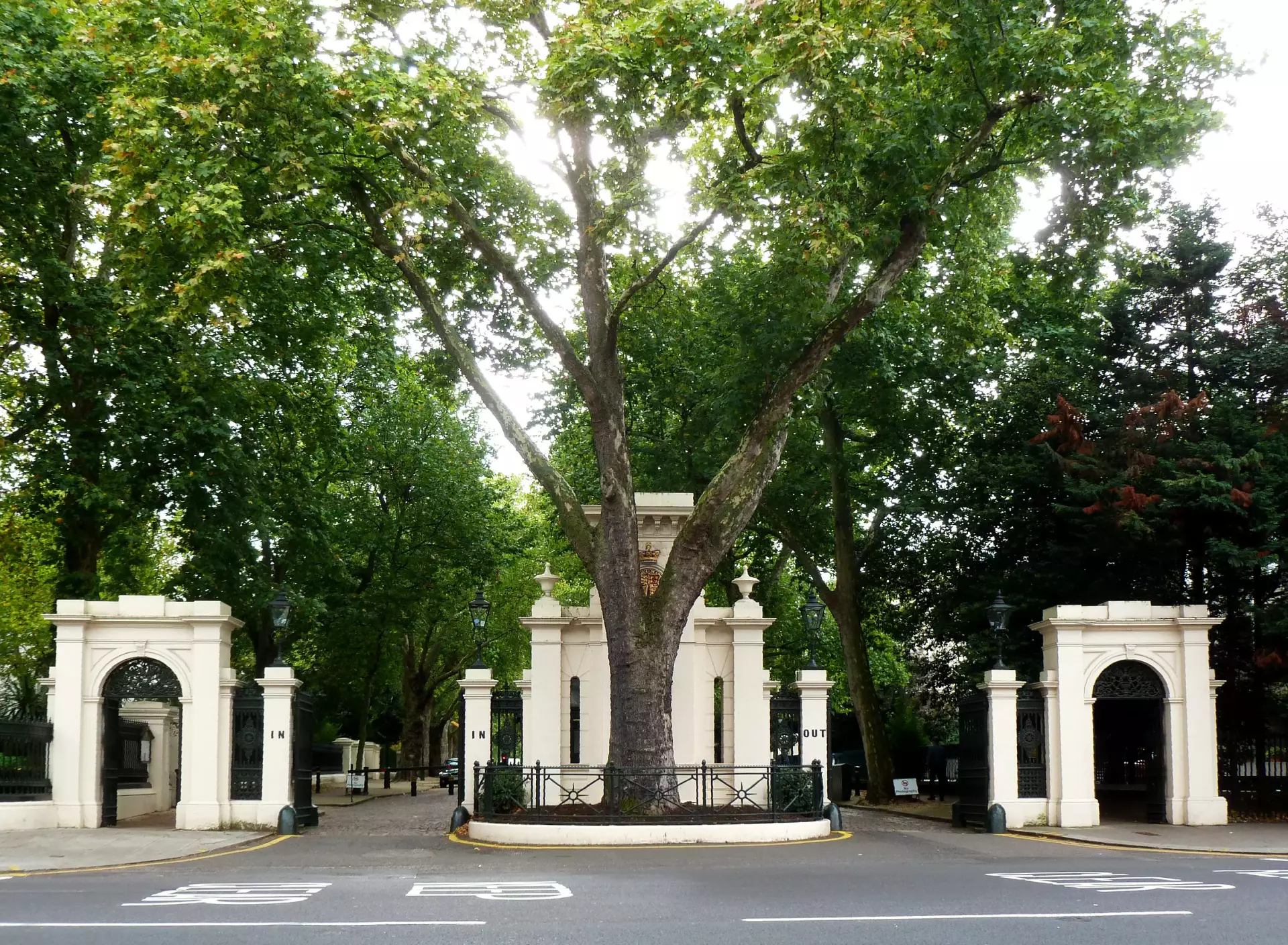
On one of the priciest residential streets in the world, a glance reveals a mix of embassies and grand ambassadorial residences. The remaining opulent mansions are home to some of the wealthiest individuals, whether from the country itself or from far-flung corners of the globe.
Adding to its intrigue, this street holds notable historical significance. During World War II, the building now serving as the Norwegian embassy was the base for King Haakon VII and the Norwegian government-in-exile. A blue plaque serves as a reminder of this significant period. Another remarkable point in history is that the street was once home to MI19's "London Cage" prisoner-of-war facility.
While there is no public right of way, the Crown Estate graciously allows pedestrians and cyclists to access the street. However, to maintain privacy and security, photography is strictly prohibited. This ensures the area maintains its exclusive and secure atmosphere.
Source - https://en.wikipedia.org/wiki/Kensington_Palace_Gardens
A small realm of serenity in the midst of the typical turmoil. It used to be the court of the Knights Templar. You can still visit the beautiful Romanesque church, which is one of the oldest ones in London (opened in 1185) and has connections to the order of Templars. The chancel of the church was built by Henry III. The church still serves the members of Gray's Inn and Lincoln's Inn and has frequent services open to the public. Fans of Dan Brown's The Da Vinci Code will recognise the church from both the novel and the film.
The eastern half of the twin parks. Of the two, Hyde Park is open for longer and has more open, unwooded land; it is often host to concerts, fun fairs and events. More of an artificial stream than a fountain, flowing in an oval through an open grassy area which, in normal summers, is a popular paddling spot for children and grown-ups alike.
This gallery houses the Tate collection of British art from 1500 through to contemporary art. A side wing collects together the gallery's collection of paintings by Turner, including some stunning seascapes. Temporary exhibitions are exceedingly varied: examples include exhibitions of Turner's paintings of Venice and the work of photographer Wolfgang Tillmans. The best known exhibition is the Turner Prize, consists of works by four artists shortlisted for the annual contemporary art prize, which runs from late October to January each year.
This enormous arch was built in front of Buckingham Palace. In 1851 the expansion of the palace meant the arch could no longer remain where it was, so it was moved to this point on Hyde Park. It now stands rather sadly on a large traffic island, but the subway beneath the roads means you can stop off at the Marble Arch on your way from Oxford St to Hyde Park.
This is probably the most famous criminal court in the world, and has been London's principal criminal court for centuries. It hears cases remitted to it from all over England and Wales as well as the Greater London area. The present building dates largely from 1907 (a new block was added from 1970 for more modern facilities) and stands on the site of the infamous medieval Newgate Gaol. The Central Criminal Court is of course best known today for its association with John Mortimer's Rumpole of the Bailey character, novels and television series. Daily case listings are available at The law pages. No bags, cameras, drinks, food or mobile phones—no facilities for safekeeping. Children under 14 are not admitted.
A modest museum covering local history which relocated in 2010; has an excellent cafe.
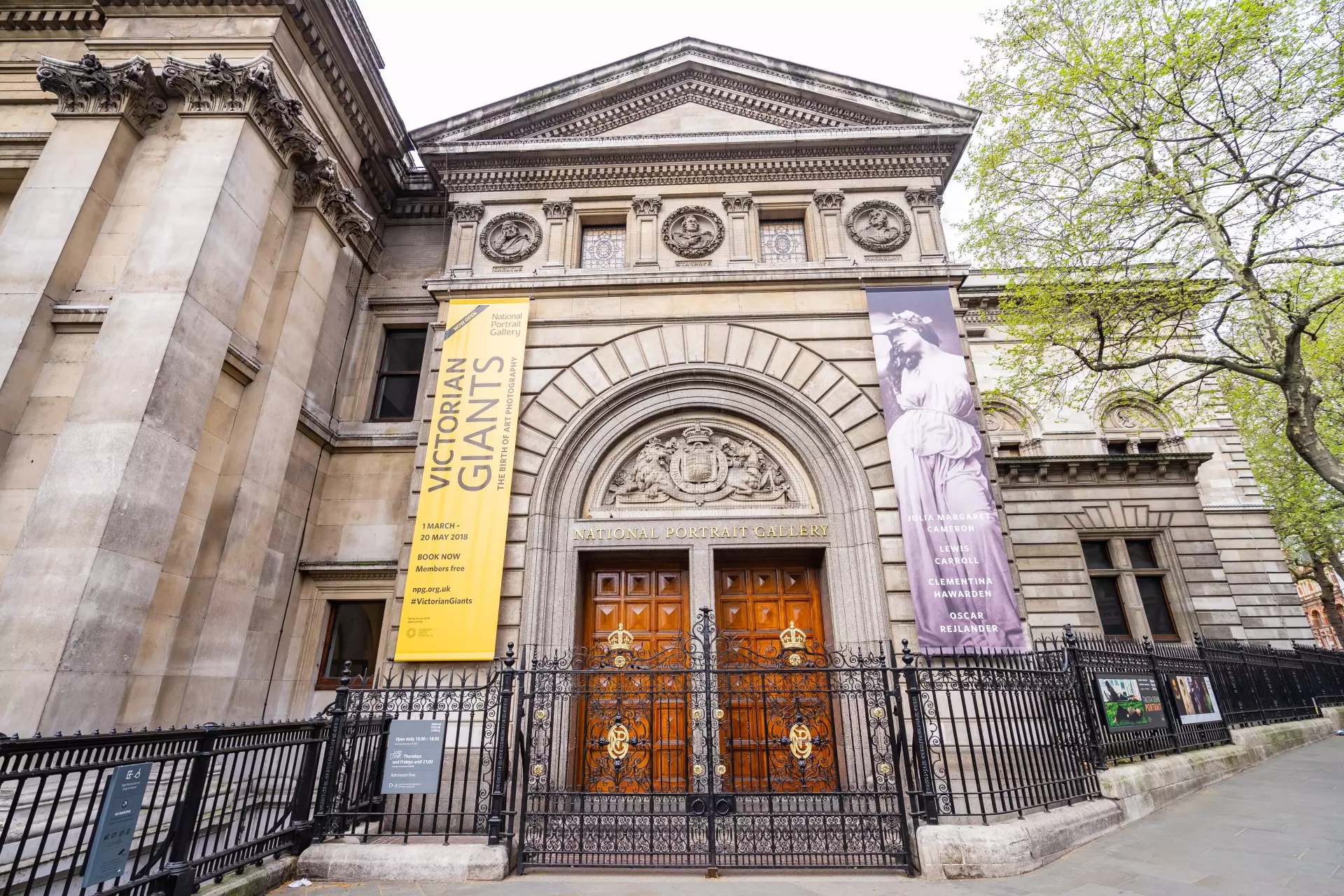
The main, central square of London, Trafalgar Square is associated with celebration and demonstration - it is the site of London's lacklustre New Year celebrations, and in 2003 was the site of the triumphant homecoming of the British Rugby team from the World Cup, and a centre for demonstration against Britain's involvement in the Iraq War. The square has been associated with the many hundreds of pigeons that used to be found here, but in 2003 a bylaw was passed to make it illegal to feed them. Nelson's Column, surrounded by the four bronze lions can be found here, on the south side of the square. The north-west plinth in the square was intended to hold an equestrian statue of William IV, but remained bare since 1841 due to insufficient funds. Since 1999, it has been used to display controversial contemporary sculpture. Houses the British national collection of western European art dating from the 13th to 19th centuries. A truly awe-inspiring collection, notable works include Hans Holbein's The Ambassadors, Van Gogh's Sunflowers and Constable's The Haywain. The vast majority of art is free of charge to visit. Temporary exhibitions are generally fairly costly, but invariably well researched and presented. The audioguides are very comprehensive, have comments on most of the paintings in the museum, and are free though this fact is not advertised. A donation is suggested. In addition to courses, workshops, lectures and other events, the National Gallery has free talks and tours every day. The National Portrait Gallery is just around the corner from the National Gallery and is an entertaining way to learn about British history since the Tudors. Visitors walk around the gallery chronologically, viewing portraits of notable figures from British history - from Henry VII, painted by Hans Holbein, to Blur, painted by Julian Opie. The High Commission of Canada immediately opposite to Trafalgar Square maintains a regular art exhibition featuring Canadian artists.
The London Mithraeum is a 3rd century Roman mithraeum that was discovered in Walbrook during construction work in 1954. The entire site was relocated several times before being returned to its original site as part of the new Bloomberg building. This temple of the mystery god Mithras became perhaps the most famous 20th-century Roman discovery in London. In addition to the temple structure, there is a display of Roman artefacts found on the site and a contemporary art exhibit responding to the site. Visitor numbers are limited and timed slots are often fully booked up several weeks into the future so plan well ahead.
The main residence of His Majesty King Charles III, Her Royal Highness Queen Camilla, and latterly of HM Queen Elizabeth II. In the summer, 19 State Rooms are open to the public. Places are strictly limited, and it might not be possible to just turn up and get a ticket for a specific entry time, visitors should book in advance to ensure admission.
After visiting the two Houses, visitors pass back through St. Stephen's Hall, and through Westminster Hall. Westminster Hall is one of the few areas of Parliament in which photography is permitted, and it is a very impressive place, dating back to the 9th century. Plaques on the floor mark where the bodies of deceased members of the royal family and other distinguished individuals granted the privilege by the British government lay in state (most recently Queen Elizabeth II in 2022), and significant events which took place in the hall (such as the trial of King Charles I).
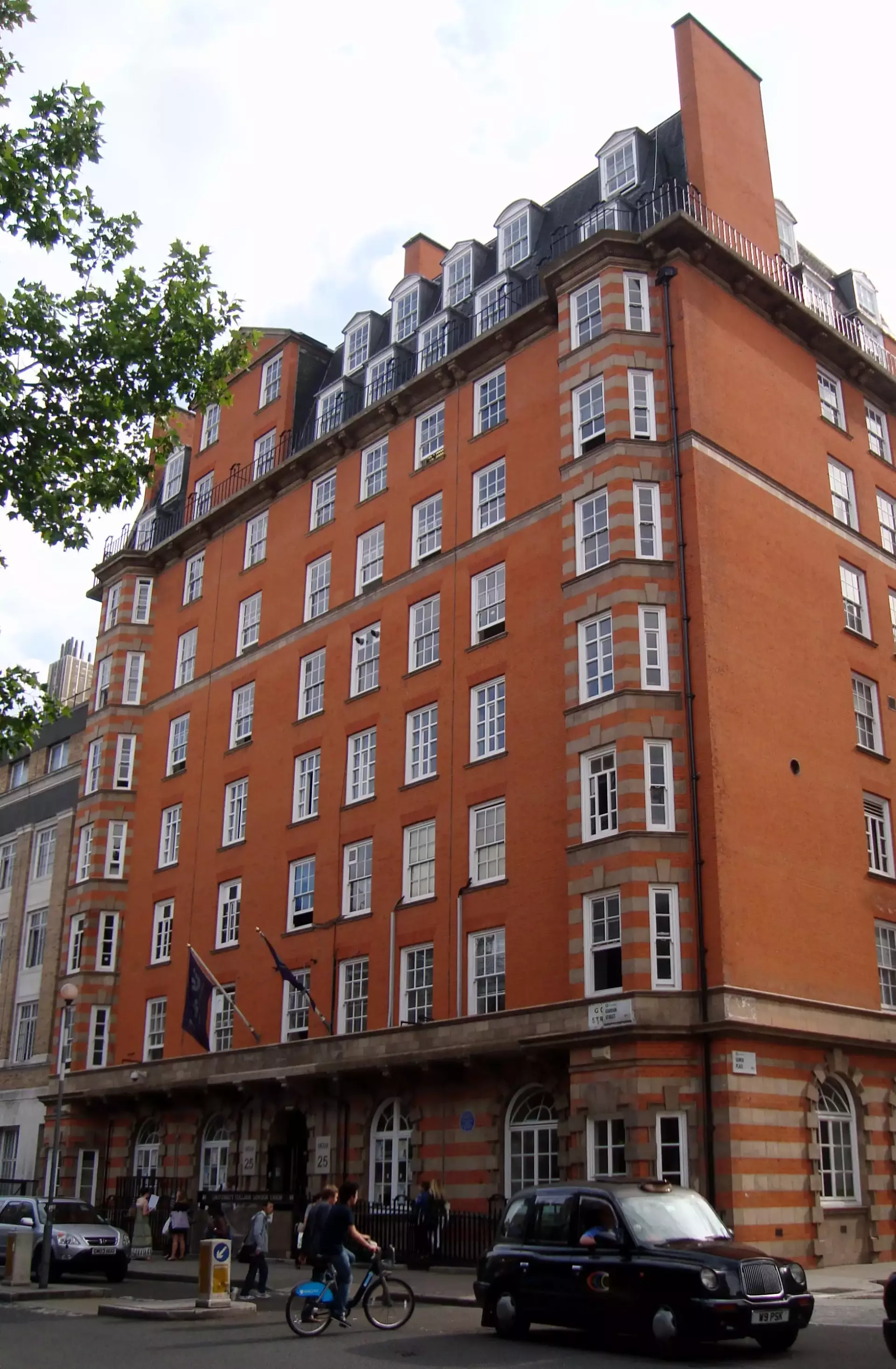
Includes a small but beautiful quad and an interesting Neo-Classical facade. The core buildings of UCL were built after the university's foundation in 1826.
The Duke and Duchess of Lauderdale's elegant 17th-century manor house, a mile or so upriver from Richmond riverside.
Designed by one of Britain's leading architects, Sir Norman Foster, this curved glass skyscraper was the 2004 recipient of the Stirling Architectural Prize for Best Building. It was built on the site of the Baltic Exchange building, destroyed in 1992 by an IRA bomb which killed three. On the Bury Street side of the Gherkin by some black stone benches is the Tomb of the Unknown Girl for a teenaged Londoner who died 1,600 years ago (see infobox above), marked with a marble laurel wreath and inscription. Searcy's Restaurant (from £50) at the top takes bookings up to five weeks in advance and you have to go through security before going up.
A neoclassical church that stands opposite the National Gallery. Since World War I, the homeless have sought shelter at this church, a tradition that continues to this day.