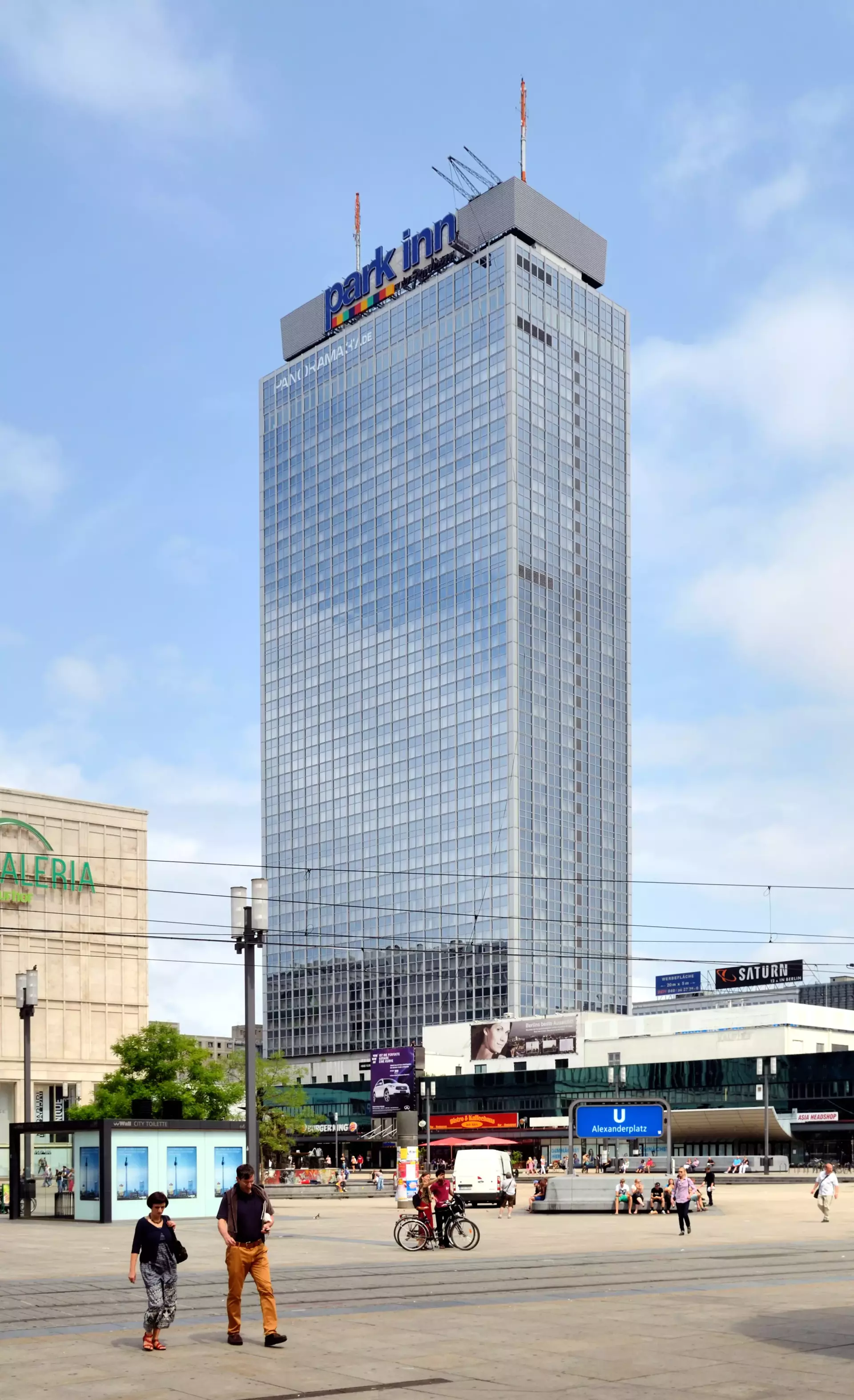
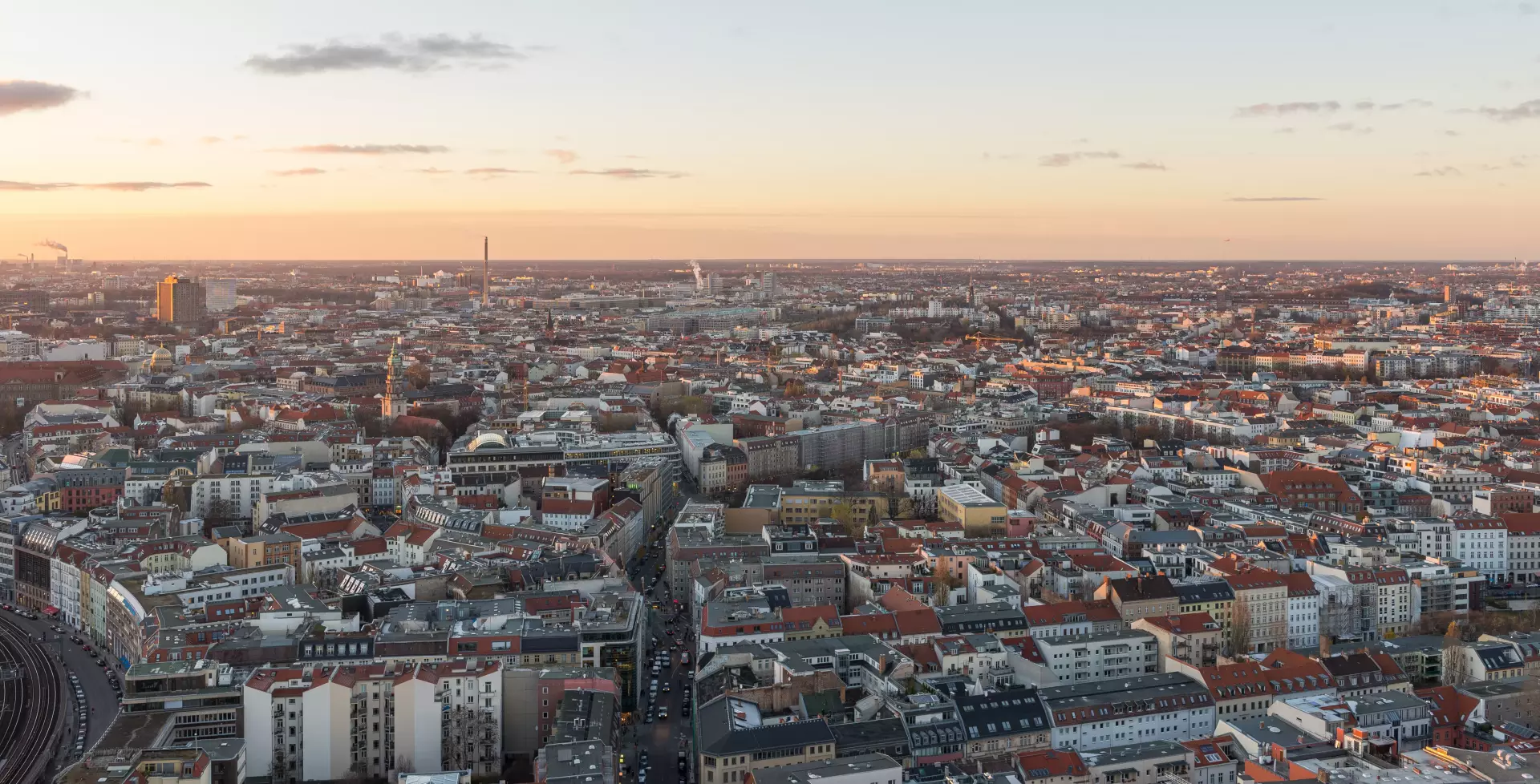
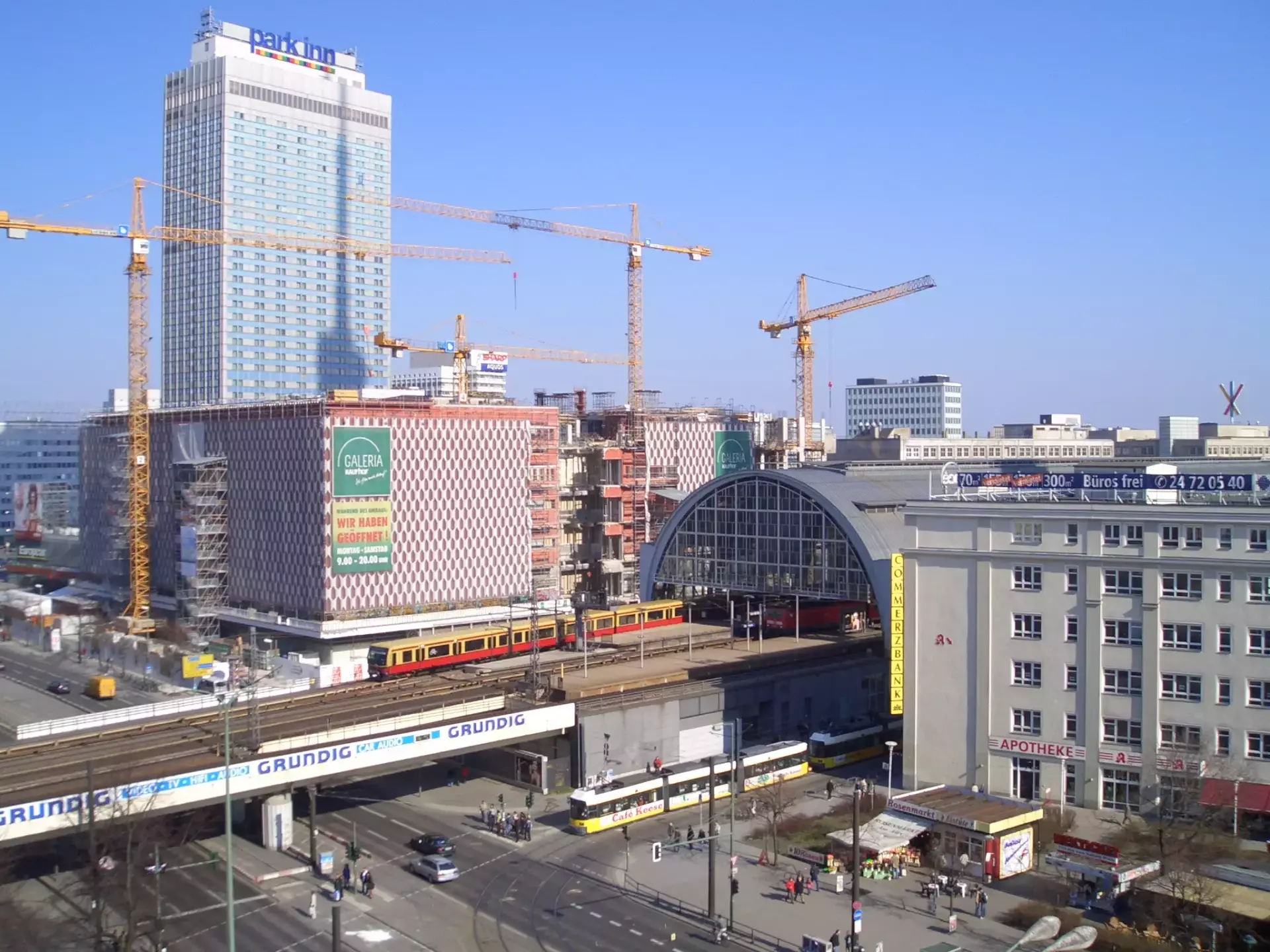
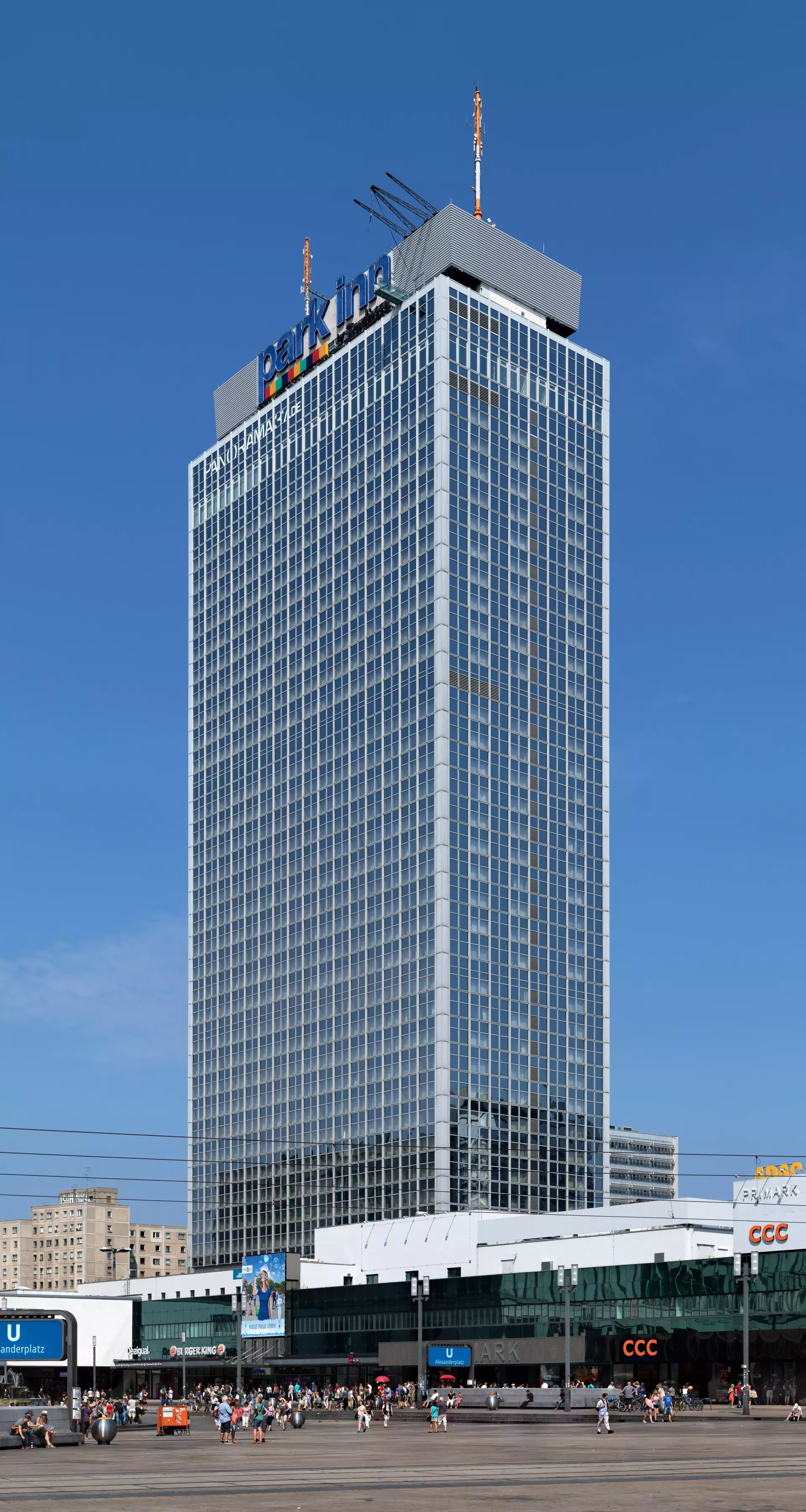
On top of the Park Inn, a small open-air terrace offers a simple way to see Berlin from above. The spot is open to the public: ride the elevator to the 40th floor and follow the signs up the final stairs. An attendant manages entry and also serves beer and coffee.
Views stretch across Alexanderplatz, with the Fernsehturm standing front and center. The vantage point is close enough to take in the tower’s details and wide enough to watch the city spread out in every direction.
Entry is handled on-site; payment is made directly to the attendant. In summer, an organized base jump experience with Jochen Schweizer is sometimes offered from the roof, adding a dramatic sideline to the usual skyline viewing.
Access depends on weather. The terrace often closes in strong wind or poor conditions, and a notice near the elevator typically confirms whether it is open or closed. On clear days, the experience is straightforward: elevator up, stairs to the terrace, and a quiet perch above the city.
Source - https://en.wikipedia.org/wiki/Park_Inn_by_Radisson_Berlin_Alexanderplatz
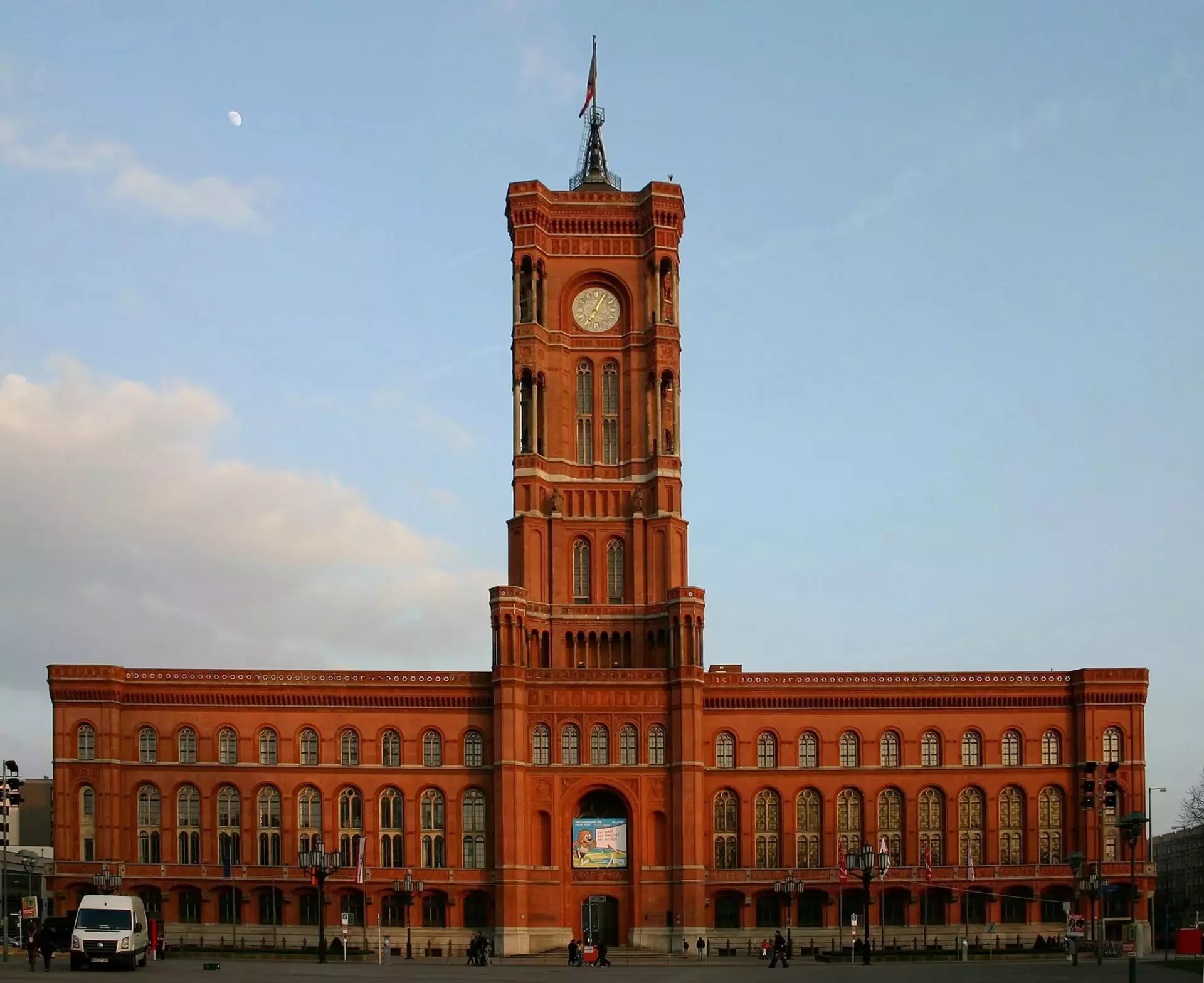
The town hall of Berlin is known as such because it is made of red brick, not due to its former political persuasion. There are nice Prussian rooms inside, which are worth a look.
Experience the Stasi Secret Police Prison first-hand. Tours are compulsory. Some of the tours are done by former inmates.
The oldest museum of its kind in Germany which, despite great losses during the World War II, still possesses one of the world's primary collections of European applied art. There are two sections to the collection: one located at the Kulturforum in Tiergarten, the other at Köpenick Palace.
A museum dedicated to everyday life in communist East Germany. The museum has very relaxed rules and you are allowed to touch and examine almost every object, which adds greatly to the experience.
It is the only hemp museum in Germany; you can see the history of hemp, the culture and use of it. You can see hemp grow. There is a cafe downstairs, with an open WiFi access. Everything going on here is legal - including the hemp growing under artificial light (a low THC strain grown with a special permit) - but they do not refrain from political commentary on the legal situation of cannabis in their exhibits.
The old town of Köpenick is surrounded by water. Especially noteworthy are the Köpenick Palace which houses a museum of applied art and the Neogothic town hall.
The Gemäldegalerie contains an astounding array of paintings, including works by Rembrandt, Rubens, Botticelli, Raphael, Titian, Goya, Velasquez and Watteau. The collection contains works from the old Bodemuseum on Museumsinsel in the East, now closed, and the former Gemäldegalerie in Dahlem. Its strong points are German paintings of the 13-16th centuries, Netherlandish painting of the 15th and 16th centuries, Flemish paintings of the 17th century, and miniature paintings of the 16th-19th centuries. In the newer section of the museum, designed by architects Heinz Hilmer and Christoph Sattler, there is enough space to display 1,150 masterpieces in the main gallery and 350 in the studio gallery - of the almost 2,900 pieces in the European painting collections. Established in 1830, the newly built gallery from 1998 has about 7,000 sq m of exhibition space (a complete tour of the 72 rooms covers almost 2 km).
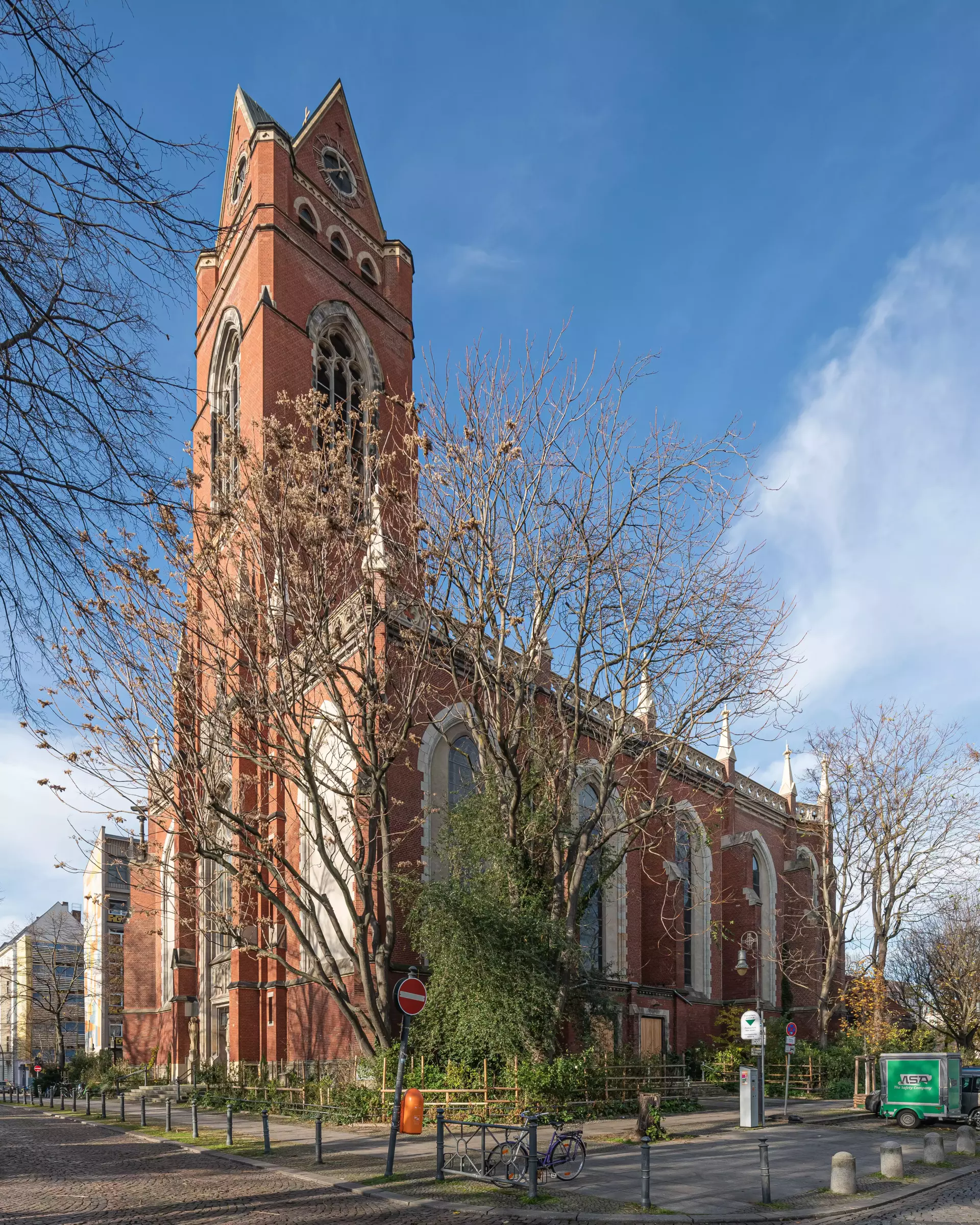
A domed church at Bebelplatz/Unter den Linden, the oldest (mid-18th century) and one of the biggest Catholic churches in Berlin. Interior was redesigned in a modern style in the 1950s, but there are still many treasure chambers in the basement.
Want to feel like one of the angels in Wim Wenders' classic film Der Himmel über Berlin (a.k.a. Wings of Desire)? Climb to the top of Gold-Else, as the statue of Victory on the top of the Victory Column is known. Just don't jump off if you're not actually an angel. Unfortunately there is no elevator, so be prepared for 285 steps to the platform at 50.7 m.Else was built to commemorate Prussian military prowess in the wars against Denmark (1864), Austria (1866) and France (1870-71), and moved to her present location by the Nazis. Five roads run into a traffic circle called Grosser Stern, in the centre of which is the Siegessäule. Else is visible from much of the city district known as Tiergarten. At the base of the statue are reliefs of war scenes representing the conflicts which this monument memorializes. The Allies forced Germany to take those panels down in 1945, but they were remounted in 1984 and 1987. It also served as a backdrop for a speech by then senator Obama in 2008, after his request to speak in front of Brandenburger Tor caused a political debate in Germany.
Became famous from the film named after this street. During the Cold War, the street was split, with one section belonging to East Berlin and one to West Berlin.
House museum on Max Liebermann, German painter and printmaker. Has about 15 Lieberman paintings.
150 m high lattice tower with open-air observation deck 124 m above ground.
Places with markets on Wednesdays and Saturdays are popular with locals at Winterfeldplatz. Buy a coffee and browse amongst the stalls; this is a place to unearth hidden gems. Breakfast is served usually until 14:00-15:00.
The area to the north of Tiergarten, along the bow of the river Spree (Spreebogen), is home to the German federal institutions such as the parliament (Bundestag, in the historic Reichstag building) and the federal government, as well as the new central train station (Hauptbahnhof) across the river.
The largest aquarium in Germany with over 9000 animals that are presented on three storeys in a historic building. Aquarium Berlin is found on the premises of the Zoo, but can also be visited separately. One of the best places on a rainy day with children.