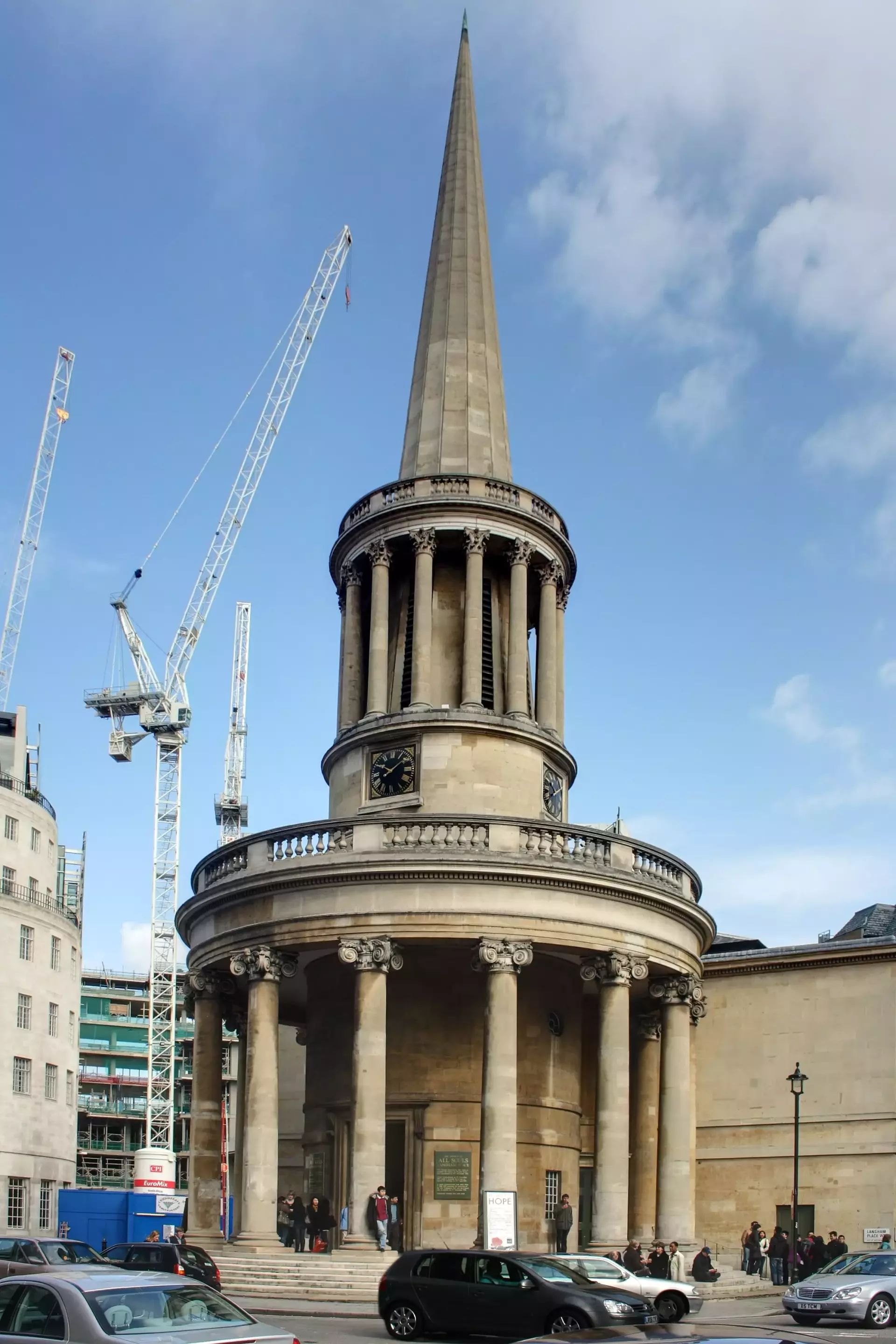
Completed in 1823, All Souls Church near Broadcasting House stands as one of John Nash's architectural masterpieces. The church features a striking spire and a distinctive circular vestibule, capturing the eye of anyone passing by.
All Souls Church showcases the unique style of John Nash, a celebrated architect known for his significant contributions to London's cityscape. The church's design reflects his mastery in combining classical elements with innovative structures. The prominent spire, rising gracefully above the circular vestibule, adds a touch of elegance to the building. This harmonious blend of architectural elements marks Nash's lasting legacy in the realm of British architecture.
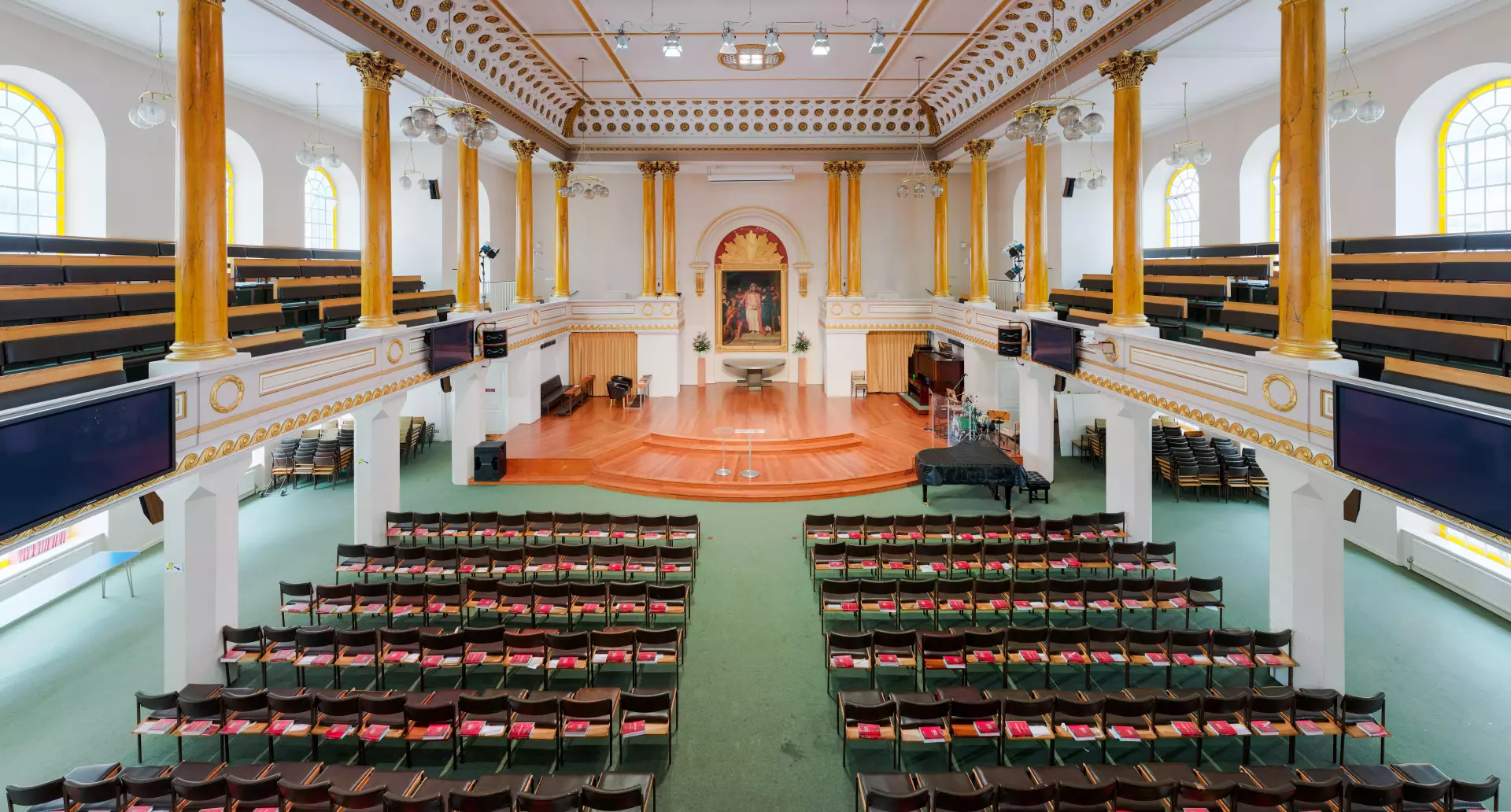
As of May 2025, the church is accessible solely for worship, offering a serene place for reflection and spiritual gatherings. While visitors may not explore the interior freely, the church continues to serve as a place of worship and community connection for those able to attend services.
Source - https://en.wikipedia.org/wiki/All_Souls_Church,_Langham_Place
An intersection of seven streets in the northern part of the Covent Garden district. Lots of mid-range designer clothing and shoe stores
A neoclassical church that stands opposite the National Gallery. Since World War I, the homeless have sought shelter at this church, a tradition that continues to this day.
An enormous, 135-metre-high observation wheel with 32 exterior glass-walled capsules. It offers incomparable views over central London and up to 40 km (25 mi) away on a good day. Tickets are sold for specific times, so if visitors wish to go on the London Eye at a specific time, they are strongly advised to book in advance, particularly in the summer. On a busy day, you can easily spend 1-3 hr queuing just to buy a ticket. However, you can also purchase tickets in advance online. Then you can collect your tickets at the London Eye in a separate queue, which takes a few minutes or less.
This venerable old institution was absorbed by the neighbouring Natural History Museum in 1985 but still has something of a separate identity. Unsurprisingly, devoted to all things geological with especially popular exhibits on vulcanology and earthquakes and fossils of all types. Very popular with kids and often underrated.
Probably the most colourful event in the UK's legislative calendar, this takes place in May or June every year, or after a general election, when the King travels to the Houses of Parliament to open the new parliamentary session. During this event, the Lords, Speaker of the House of Commons, and other office holders can be seen dressed in their ceremonial robes, and there is always an elaborate procession when the King makes his way to the Houses of Parliament from Buckingham Palace. This is one of the few occasions where all branches of the British government are gathered in the same place. Many traditions of the State Opening can trace their origins to a more turbulent past, when the relationship between the monarch and Parliament was sometimes antagonistic. In particular, since the English Civil War, the monarch has been banned from entering the House of Commons chamber, and instead must send a representative (the Black Rod) to summon the MPs to the Lords chamber, where he delivers his speech. Another notable tradition is the holding of a Hostage MP in Buckingham Palace, ostensibly to guarantee the safe return of the monarch, who is released once the King has returned to the palace safely after delivering his speech. While attendance at Parliament itself is limited to special guests that have been invited by the Prime Minister, it is broadcast live on the BBC, and you can also view the King's procession from Buckingham Palace to Parliament from the roadside for free.
One of the most expensive residential streets on the planet! Most of the buildings here are embassies or ambassadorial residences but the rest of the mansions belong to some of the richest people in the country (or elsewhere). For added historical value, during World War II, the current Norwegian embassy was where King Haakon VII led the Norwegian government-in-exile (commemorated by a blue plaque) and MI19's "London Cage" prisoner-of-war facility was located here. There is no public right of way but the Crown Estate allow pedestrians and cyclists to use the street; photography is not permitted.
This enormous arch was built in front of Buckingham Palace. In 1851 the expansion of the palace meant the arch could no longer remain where it was, so it was moved to this point on Hyde Park. It now stands rather sadly on a large traffic island, but the subway beneath the roads means you can stop off at the Marble Arch on your way from Oxford St to Hyde Park.
Remains of the wall that surrounded the City of London for almost two thousand years. The parts around the Barbican are mostly Tudor due to maintenance (Roman remains can be seen in and around the Tower of London). Other local remains are the 51.5169-0.095833 Noble St wall fragment and the 51.5177-0.092234 St Alphage Gdns wall fragment.
A branch of the Imperial War Museum, the Cabinet War Rooms preserves the underground corridors and rooms from which Churchill and the cabinet directed the war against Hitler and the Nazis, maintained almost exactly as they were left in 1945. In 1984, IWM opened the rooms to the public for the first time. In 2005, the attached Churchill Museum was opened as the world's first permanent museum dedicated to the life and wartime achievements of Sir Winston Churchill. Audio guides are included in your admission. No cloakroom, no rucksacks, no suitcases. Café is open daily from 10am to 5pm. Hot food is served until 3pm.
The former home of Sigmund Freud. A wide range of exhibits, most famously including the psycho-analytic couch that all of his patients used. Freud was an avid collector of antiquities and there is a fine collection of Greek, Roman and Oriental pieces on show.
Museum at the former home of Dickens exhibiting writings, paintings, furniture and other items relating to the writer.
Dr Samuel Johnson was the highly distinguished 18th-century "man of letters", best known for his comprehensive English Dictionary of 1755, but also for his prolific output of poems, essays and novels. Something of a "hidden gem", this small, independent museum is dedicated to him—and, with its historic interiors, paintings and prints, personal effects and other exhibits—gives an impression of what it might have been like during his occupancy from 1748 to 1759. Built in 1700, this impressive period building—a rare example of its kind in the area—survived the brutal onslaught of the Blitz during World War II and is now maintained in excellent condition.
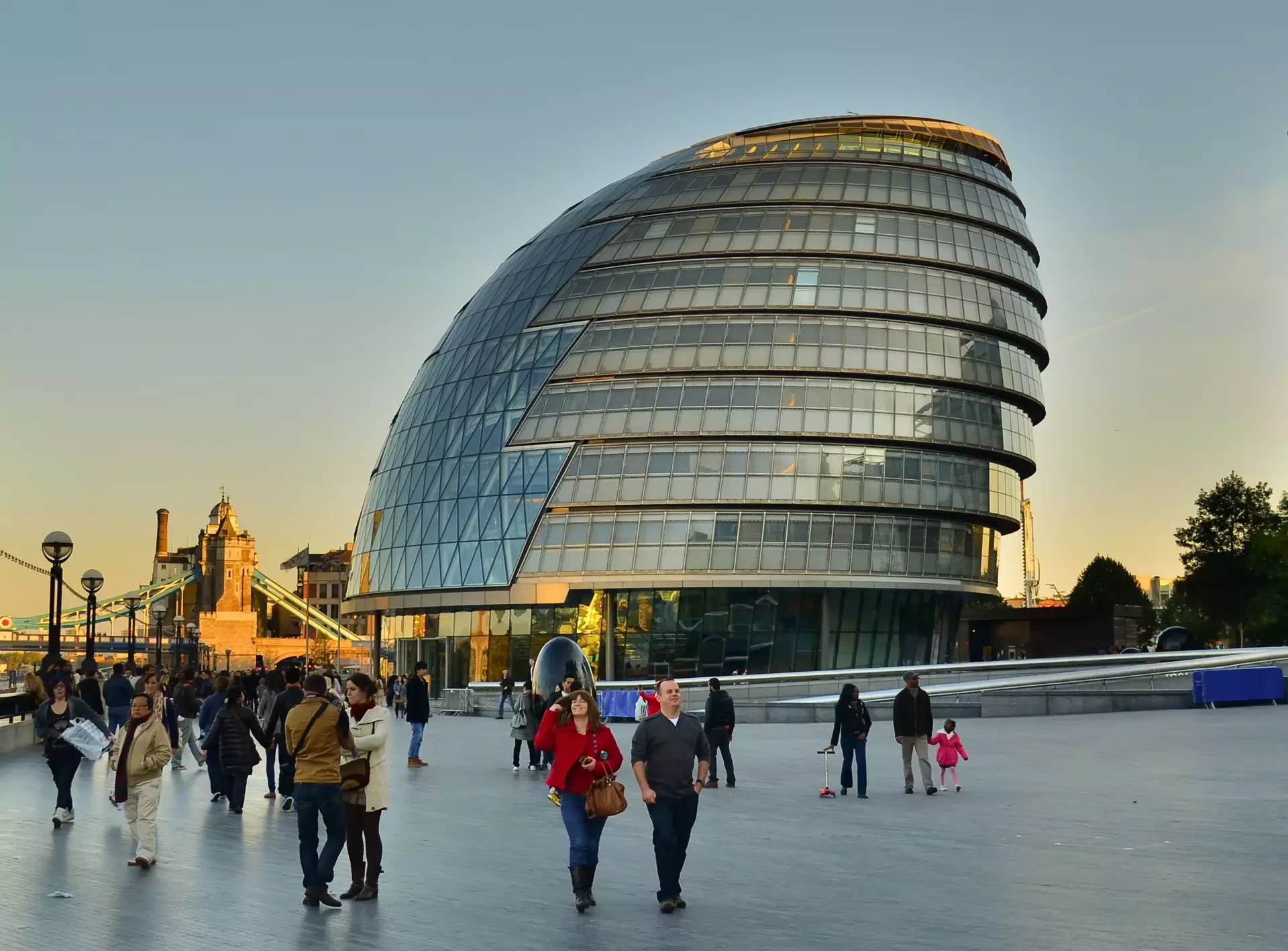
Former offices of the Greater London Authority. A radically-designed glass fronted and rounded building, previously headquarters for London's Mayor and Assembly. City Hall has now be relocated to The Crystal, a building in Greenwich, near to the cable car. The old building is disused and not open to the public, but can be viewed from the outside.