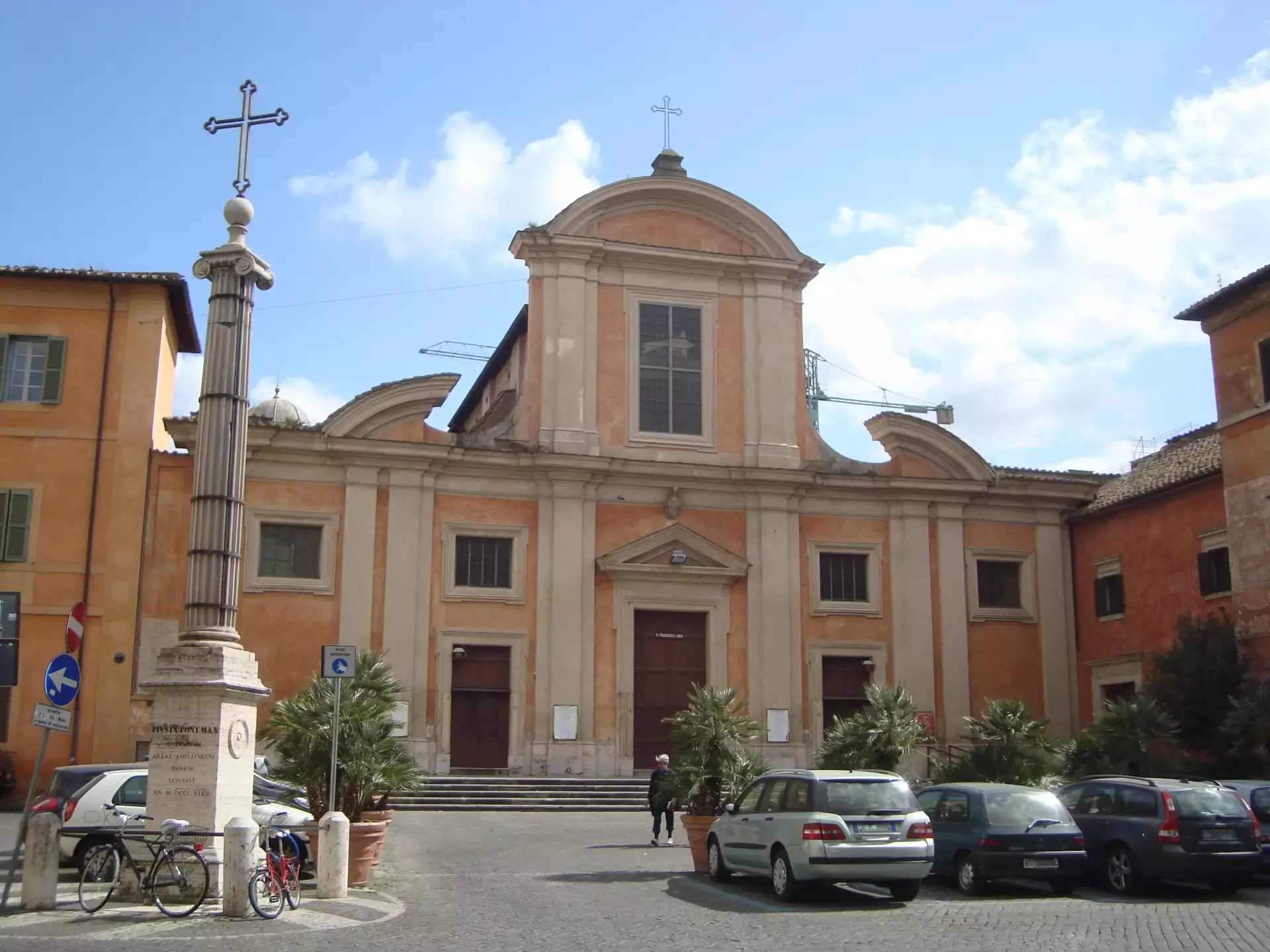
San Francesco a Ripa is a church named in honor of St. Francis of Assisi, who once stayed in the surrounding area. The church holds a special place in local history because of this connection to the beloved saint.
Within the Paluzzi-Albertoni chapel, visitors can find one of Gian Lorenzo Bernini’s most celebrated sculptures: the statue of the Blessed Ludovica Albertoni. This artwork is admired for its detailed craftsmanship and emotional depth, drawing the attention of art lovers from around the world.
In front of the church stands a column with a story of its own. This ancient column was brought from the ruins of Veii, an old Etruscan city north of Rome. Its presence adds a historical layer, linking San Francesco a Ripa to Rome’s ancient past.
Source - https://en.wikipedia.org/wiki/San_Francesco_a_Ripa
A very ancient church named after a saint who was in 1969 removed from the Roman Catholic calendar of saints for the lack of details of her life. But the church retains the name and is well worth visiting for an excellent 4th-century mosaic and attractive decorations on the facade. Visiting hours are short, but if you arrive close to 11:30, try talking to the attendant if you see him, and he might let you visit for a few minutes. The church is small, so 15 minutes should be long enough to see and absorb everything.
Underground burial place of an ancient Roman family and of seven early popes.
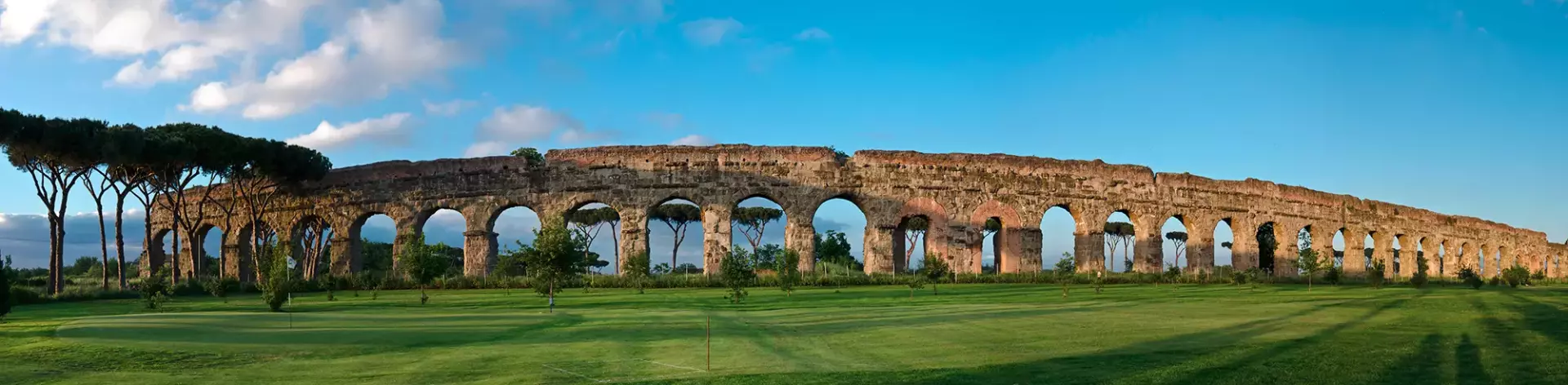
Caffarella Park covers an area of 339 ha and is part of the larger Appia Antica park. It contains both a working farm and numerous Roman ruins, some quite well preserved and is a great place for a stroll or cycle away from Rome’s traffic.
Located a short walk west of the Colosseum, this well-preserved monumental arch was erected (soon after 315) to commemorate the victory of Constantine, the first Christian emperor, over his rival Maxentius at the Battle of the Milvian Bridge in 312. In general design, the Arch of Constantine imitates the century-earlier Arch of Septimius Severus (nearby in the Forum). The three arches are decorated utilizing mainly materials plundered from other imperial monuments by Trajan, Hadrian and Marcus Aurelius. The quality of its sculptural decoration, however, betrays the slow degradation that Classical Roman sculpture had experienced in the 3rd century AD.
Between the Pantheon and Via del Corso. A stunning example of Baroque art. The ceiling frescoes are especially fine, including a trompe l'oeil dome by the master Andrea Pozzo.
Pope Nicholas III connected Castel Sant'Angelo to St. Peter's by a covered fortified corridor called the Passetto di Borgo. This proved useful for Pope Clement VII during the Sack of Rome (1527). You can still see much of the Passetto by walking along the Borgo Sant'Angelo, which runs parallel to, and north of, the Via della Conciliazione.
The chains that allegedly held St. Peter are displayed in a case before the altar. More importantly, contains the impressive statue of Moses by Michelangelo. It's close to the Colosseum, but a little hard to find. Take the steps opposite the Colosseum on Via dei Fori Imperiali, cross the road at the top and seek directions. Also reachable through steps to the right leading off Via Cavour.
The house in which the famous English poet John Keats succumbed to consumption, now preserved as a memorial to his life and that of his friend Shelley, both of whom are buried in Rome's Protestant Cemetery (see Testaccio).
It was immortalised in 1960 by the Federico Fellini film La Dolce Vita. It is also the location of the US Embassy, in the massive Palazzo Margherita. Via Veneto went into a period of decline in the 1980s but has returned to popularity and the roadside cafes are the place to be seen if you are into that sort of thing.
The contours of the ancient stadium, built in the 6th Century B.C., are still visible in what is now a park in the shadow of the Palatine. Circus Maximus was primarily devoted to chariot races and was used for this purpose until around 550 AD. The stadium could seat up to 150,000 people. Originally built of wood, it burnt down twice, on the second occasion starting the great fire when the Emperor Nero was said to fiddle while Rome burned. It was in one of the tunnels here that Caligula met his end. Excavations began in 2009 at the east end of the circus and are likely to go on for some years.
The Celian Hill is one of the seven hills of Rome. You immediately see the church of San Gregorio Magno. On this site monks were trained before setting off as missionaries to England at the end of the 6th Century. Further up the hill is Santi Giovanni e Paolo. At this point it is difficult to believe you are in the middle of a major city. This church was built in 398 over the home of two Roman soldiers, John and Paul, who were martyred for their Christian beliefs in 362. Excavations show that there were several burials on the site, a risky business as burials were illegal at that time. After the church you come to the back entrance of the Villa Celimontana park (jazz festival nightly in late June-August). The modern buildings before you reach the park are owned by Silvio Berlusconi’s television company. By the main entrance of the park note the boat-like fountain known as the “Navicella”. As you exit the main entrance to the left is the church of S. Maria in Domnica, which has some interesting mosaics. Next to this church is the Porta Esquilina, one of the gates from the original Servian walls of Rome. It dates back to the 4th century BC.
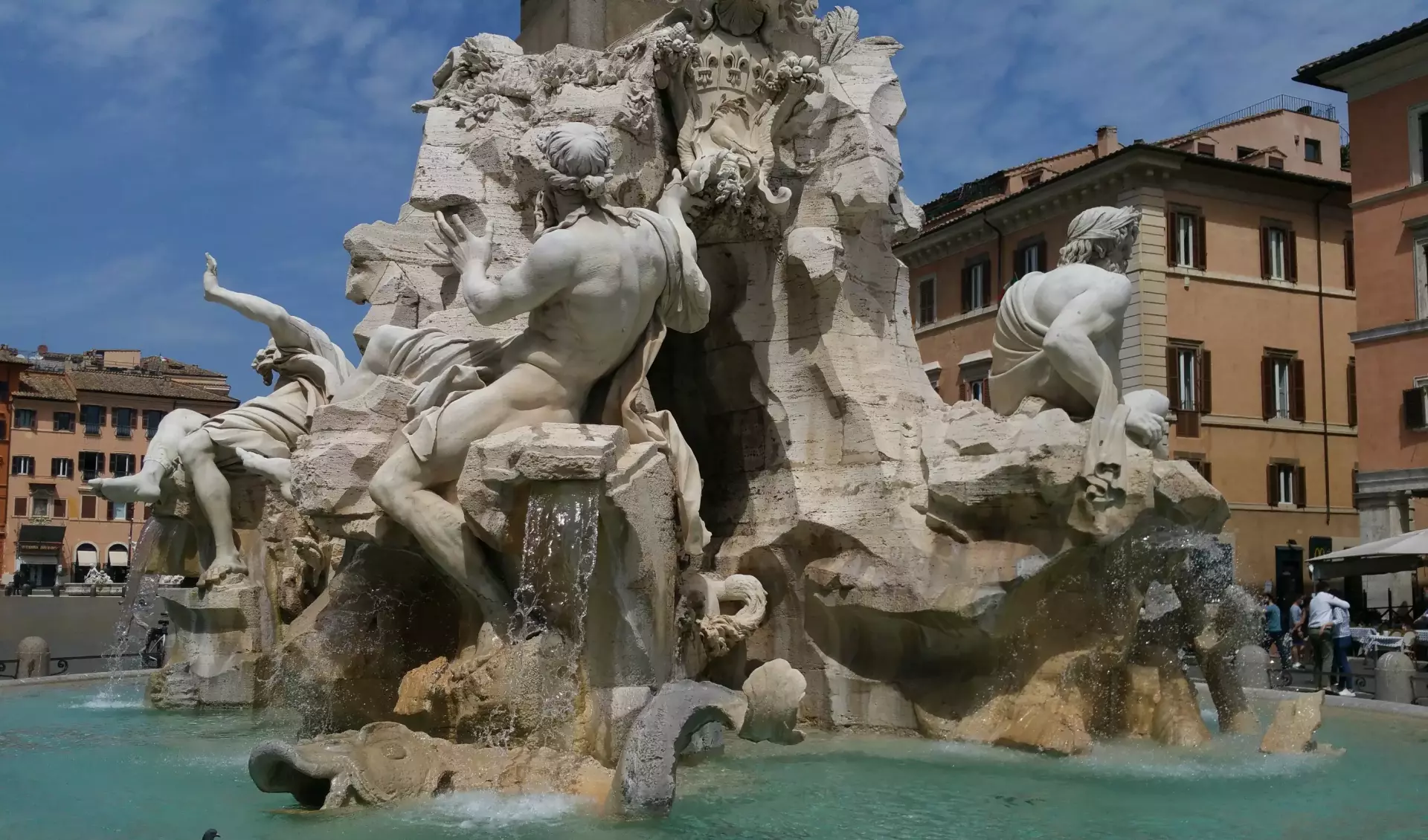
One of Bernini's masterpieces, an obelisk on the back of an elephant.
The building is in one of the most hidden corners of the city center among Piazza Navona and Castel Sant'Angelo. It served as residence for the Orsini family. Nowadays it is private property and one can only glance at the courtyard and the amazing fountain inside, erected in 1618 by architect Antonio Casoni. However, the brief moment is worth it.
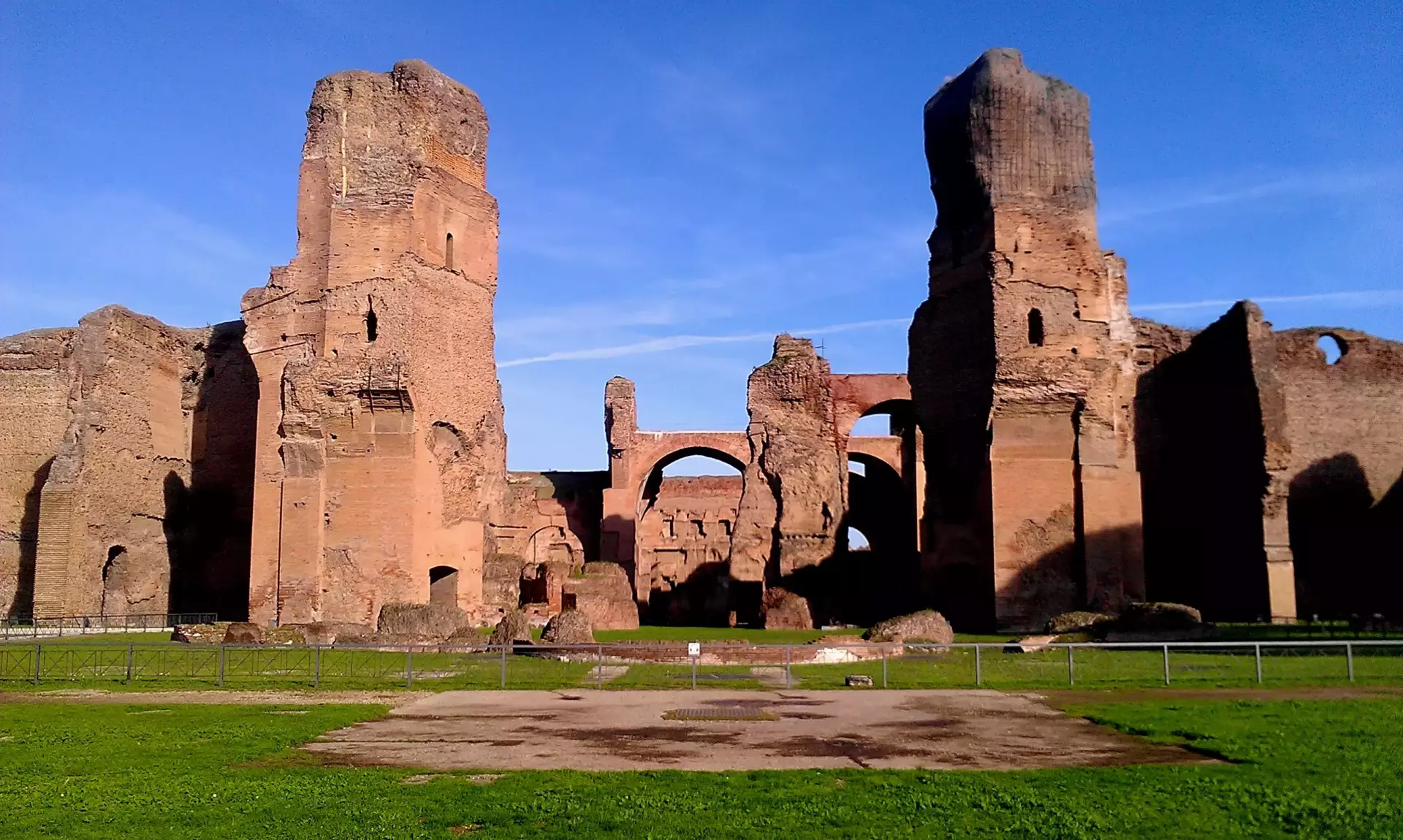
Inaugurated in 217 AD and used until the 6th Century. The baths were big enough for 1600 bathers at a time. Impressive and well-preserved. Used for operas in summer months (see Opera di Roma for details) and was the location for the famous "three tenors" concert in July 1990, at the time of the World Cup (soccer).
This is a large tomb built by the Roman Emperor Augustus in 28 BC in the form of a stone ring covered by an earth mound. A brick wall, 87 m in diameter, carried an earth mound covered with cypresses. On top of the hill stood a bronze monument of the emperor. The building was 44 meters high. At the beginning of the alley, which led to the tomb were two Egyptian obelisks. On both sides of the doorway bronze plates describe the "Res gestae", the deeds of the emperor. The urns of Augustus, Marcellus, Octavia, Agrippa, Drusus and other members of the Julian Claudian dynasty were revered here. In the Middles Ages the building served as citadel of the Colonna family. It was destroyed by Pope Gregor IX in 1241. The body of Cola di Rienzo. a popular leader of the people in the mid-14th century, was burnt in this monument. The Mausoleo di Augusto is not open to the public, and is fenced off.