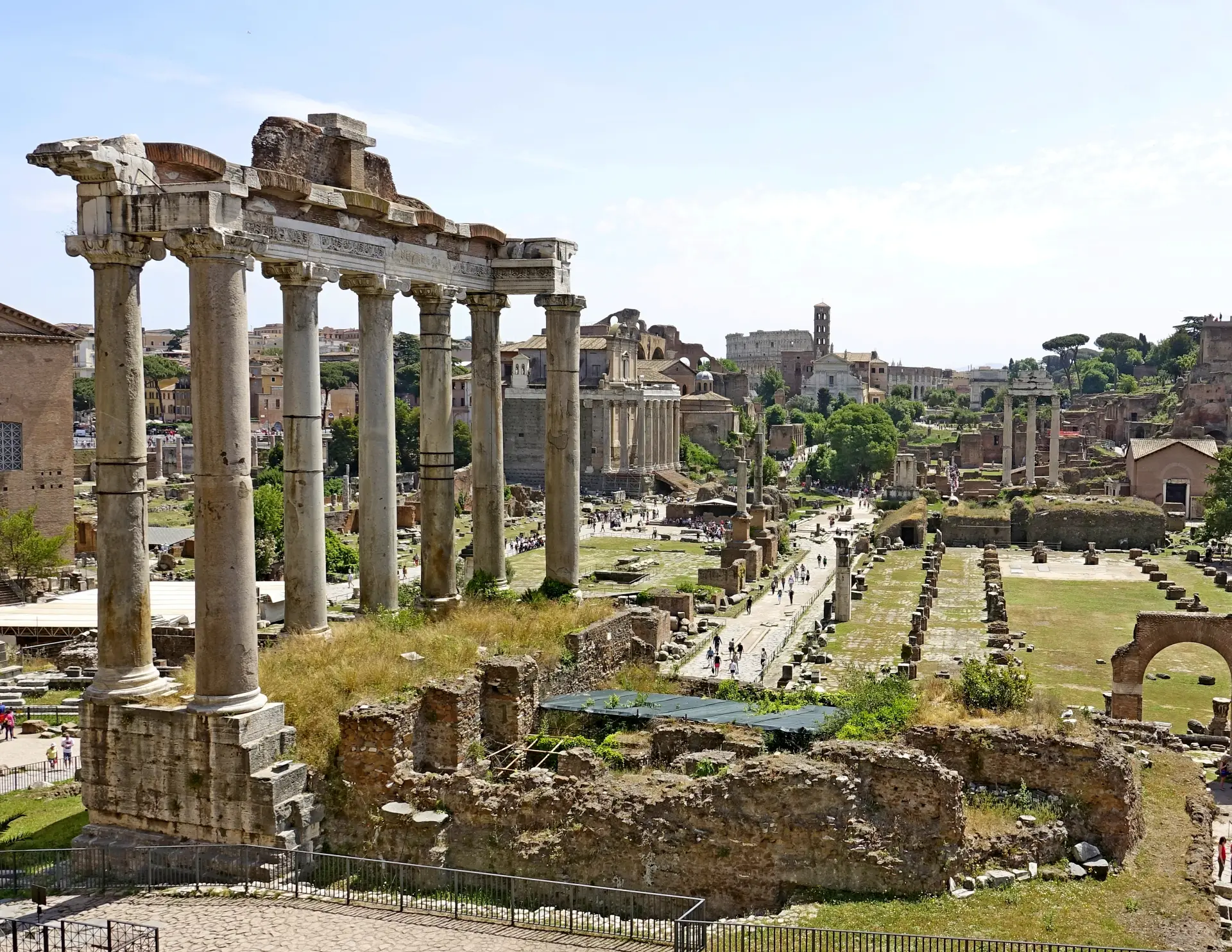
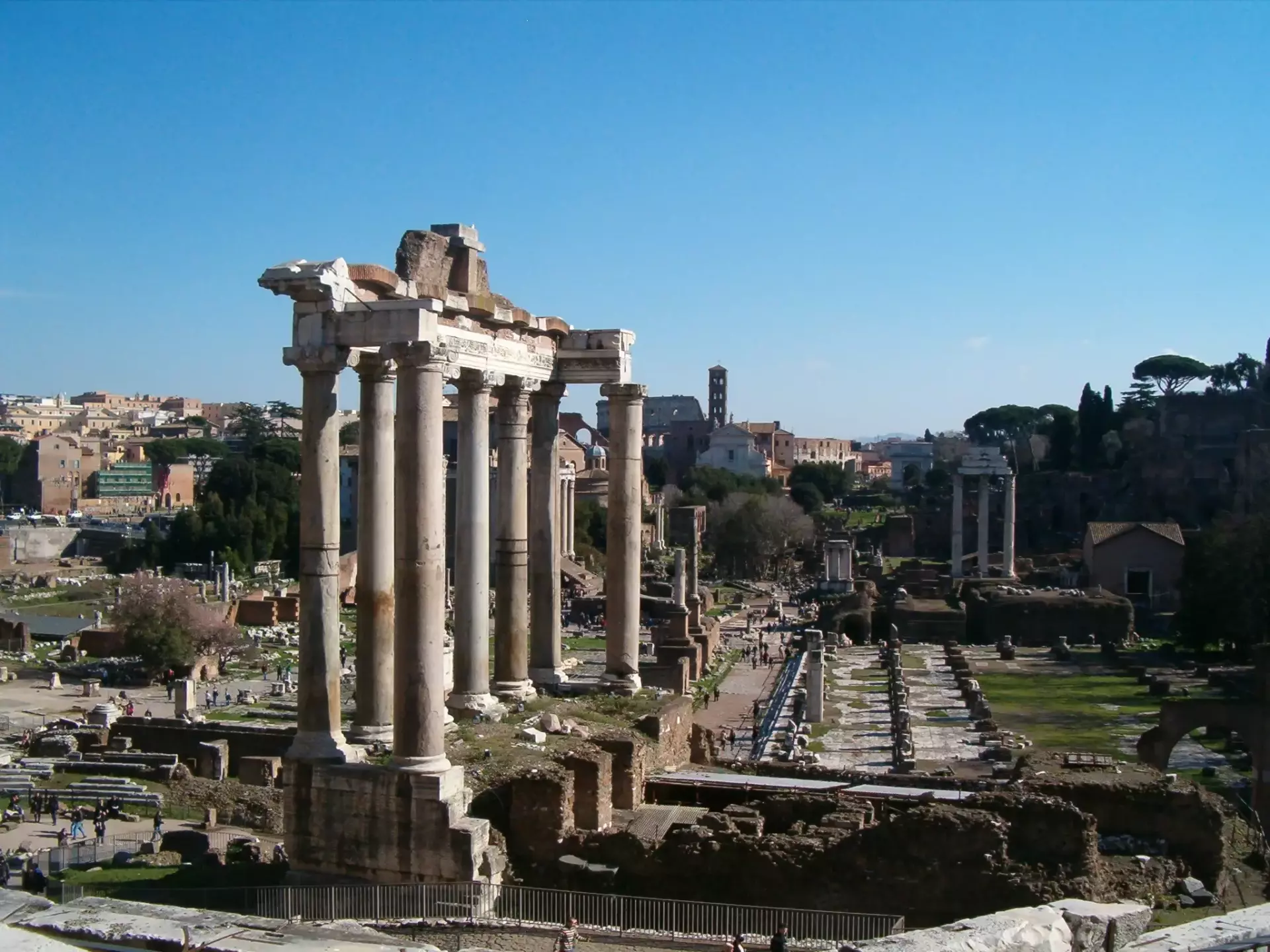
Stepping into the Roman Forum, the bustling center of ancient Rome, feels like traveling back in time. Nestled amid the ruins lies the imposing Temple of Saturn, an enduring symbol of Rome's glory and resilience. As I approached it, my imagination soared, trying to envision the grandeur that once stood where now only remnants remain.
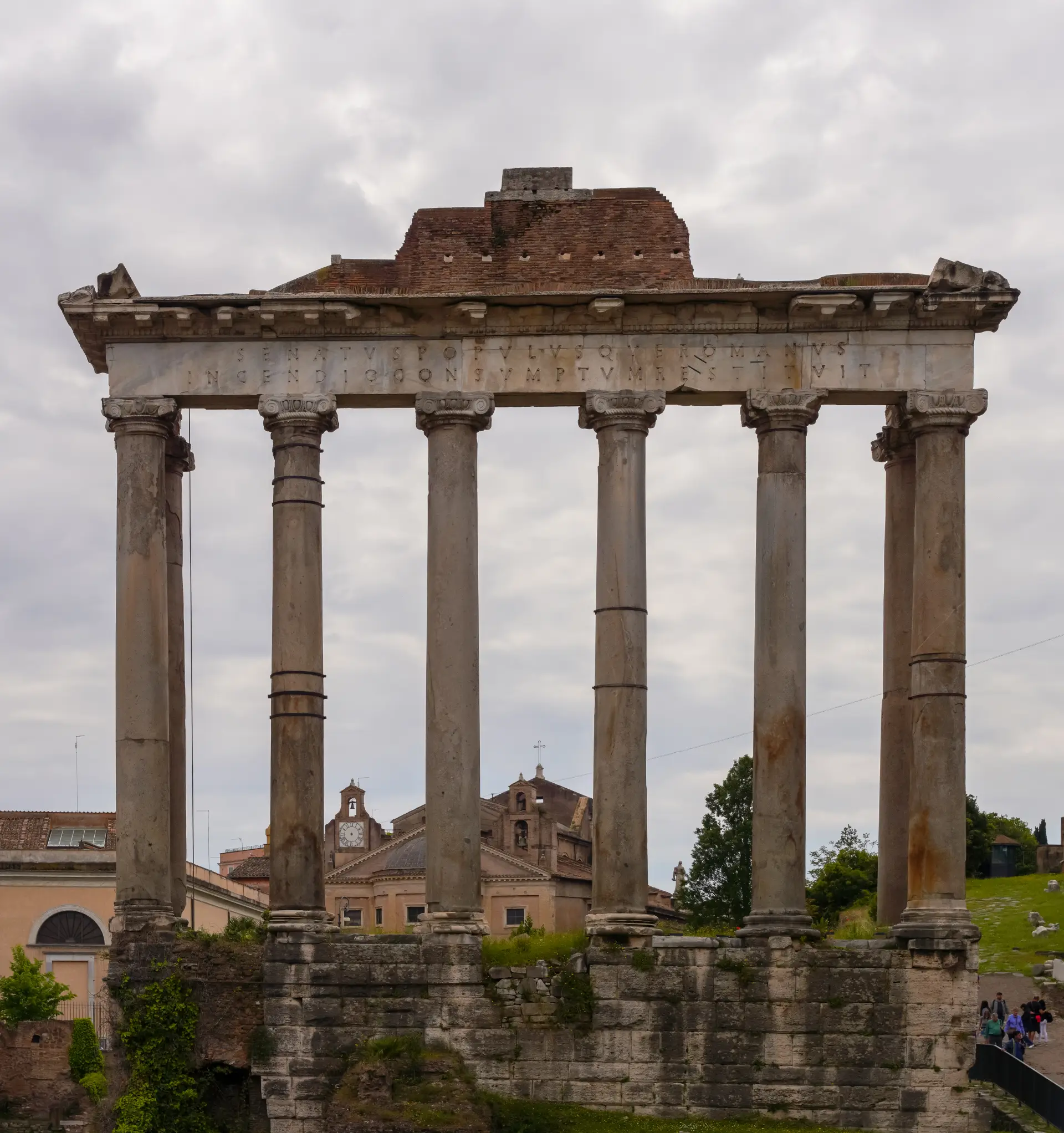
The Temple of Saturn, one of the oldest sacred sites in the city, stands proudly with its eight surviving columns reaching into the sky. Historically, it was dedicated to Saturn, the god of wealth and agriculture, and was once home to an illustrious statue of the deity himself. Today, these columns serve as towering guardians of the past, silently watching over the tourists who flock to admire their splendor.
Visiting the site, I was captivated by the architectural prowess of the ancient Romans, who constructed this temple in 497 BC. Each weathered marble column told its own tale of the passage of time, enduring through centuries of wear, earthquakes, and the relentless force of nature.
Standing beneath the shadow of the columns, I couldn't help but ponder the rich history embedded within the stones. The Temple of Saturn once housed the Roman treasury, holding wealth that was pivotal in shaping the burgeoning empire. Back in its heyday, it was the site of the Saturnalia festival, a time of cheerful celebration and social inversion, reminding Romans to live freely and joyously.
This historical context adds a layer of depth to any visit, making it not just a walk among ruins, but a journey through a mosaic of stories that have shaped our world today.
To truly appreciate the Temple of Saturn, understanding its cultural significance is essential. The temple's legacy is woven into the fabric of Rome, representing resilience and the cyclical nature of time. In its decay, we see the slow yet inevitable transformation of civilizations, an ongoing dance between preservation and progress.
For anyone drawn to history or architecture, the allure of the Temple of Saturn is irresistible. It's a place where the whispers of the past blend harmoniously with the chatter of present-day visitors, creating a dynamic narrative that is both ancient and ever-evolving.
In reflecting on my journey, it became evident that the Temple of Saturn is more than just an archaeological wonder; it is a tangible connection to a time when the world was very different but also much the same. It's a must-visit for any traveler seeking to experience the profound tales enshrined in Rome's rich tapestry.
Whether you're a seasoned historian or a casual tourist, the magic of the Temple of Saturn lies in its ability to transport you to an era of gods and legends, making it an unforgettable stop on any Roman adventure.
Source - https://en.wikipedia.org/wiki/Temple_of_Saturn
On the site of the Roman baths, this museum houses an enormous collection of statues, etc.
Ballroom-like church which crowns part of the Capitoline Hill. Don't be fooled by the plain stone exterior.
Pope Nicholas III connected Castel Sant'Angelo to St. Peter's by a covered fortified corridor called the Passetto di Borgo. This proved useful for Pope Clement VII during the Sack of Rome (1527). You can still see much of the Passetto by walking along the Borgo Sant'Angelo, which runs parallel to, and north of, the Via della Conciliazione.
A very ancient church named after a saint who was in 1969 removed from the Roman Catholic calendar of saints for the lack of details of her life. But the church retains the name and is well worth visiting for an excellent 4th-century mosaic and attractive decorations on the facade. Visiting hours are short, but if you arrive close to 11:30, try talking to the attendant if you see him, and he might let you visit for a few minutes. The church is small, so 15 minutes should be long enough to see and absorb everything.
A truly quiet oasis close to the hustle and bustle of EUR. There are three churches in this complex and the doors are open all day, unlike city churches. The monks produce a range of products such as liqueurs, chocolate and honey, as well as a cure for the illnesses Romans suffer when the Scirocco wind blows in from the Sahara. These are on sale at a shop at the Abbey.
Rome's museum of contemporary art, housed in a former industrial complex. Rotating exhibitions, each one usually lasting about 4 months. The MACRO Testaccio exhibition space is located in Aventino-Testaccio.
Not, as commonly believed, named after the country but after the city of Strasbourg (Argentoratum in Latin), from which came a courtesan of Pope Alexander VI who lived nearby. Four Roman Republican-era temples, Pompey's theater and a Roman public toilet ("Latrina") have been excavated. The Pompey Theater is the site where Julius Caesar was stabbed to death by senators in 44 BC. The largo is also home to a large number of cats which are tended by the local animal rights organization - purportedly a jab at Mussolini who excavated the area and is said to have hated cats. As of September 2024 no cats could be seen at least from the street.
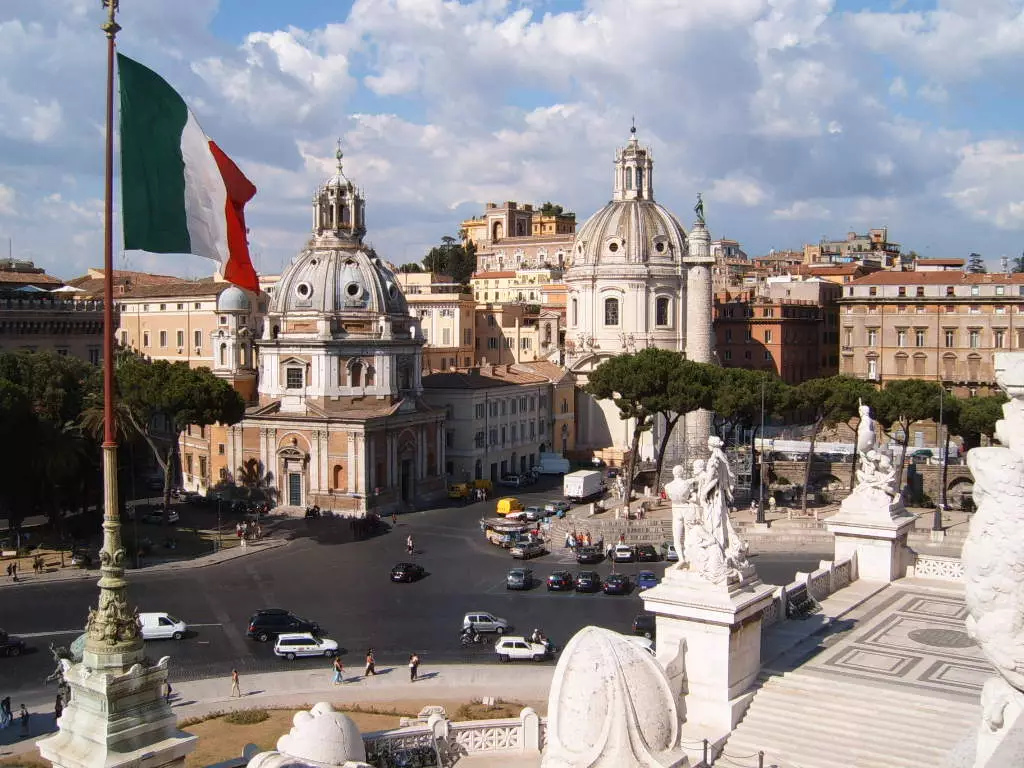
More of an enormous traffic circle than a piazza, but a good central location. The centerpiece is the enormous Vittorio Emanuele Monument (aka the Wedding Cake or the Typewriter) with the Capitoline hill next door. Mussolini used to harangue Romans from the first floor balcony of Palazzo Venezia (see under Museums), to the west of the square.
A tomb for the wealthy Gaius Cestius, who died in 12 BC. Admission to the monument only by guided tours on specific dates (2nd and 4th Saturday every month, and in combination with a ticket to the Museum of Via Ostiense also on the 1st and 3rd Saturday of every month).
Built after 1631, the crypt of the church contains a macabre display - a series of chapels decorated with the bones of 3700 dead friars. The bones are glued to the walls and ceilings in bizarre and striking decorations.
The museum is dedicated to Napoleon Bonaparte and his family. After Napoleon's death in 1821 the Pope gave permission to his family to settle down in Rome. His sister married Prince Camillo Borghese.