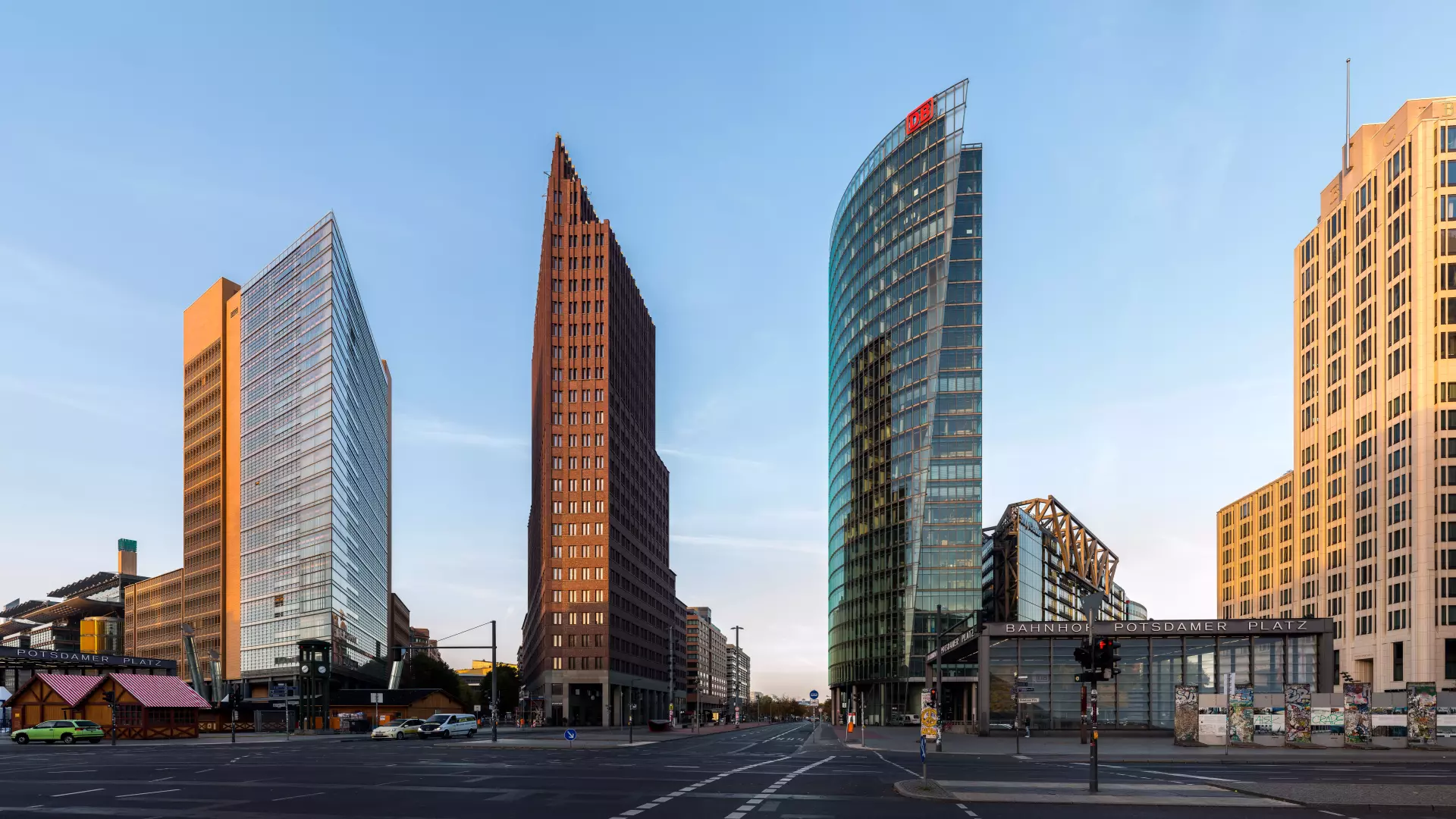
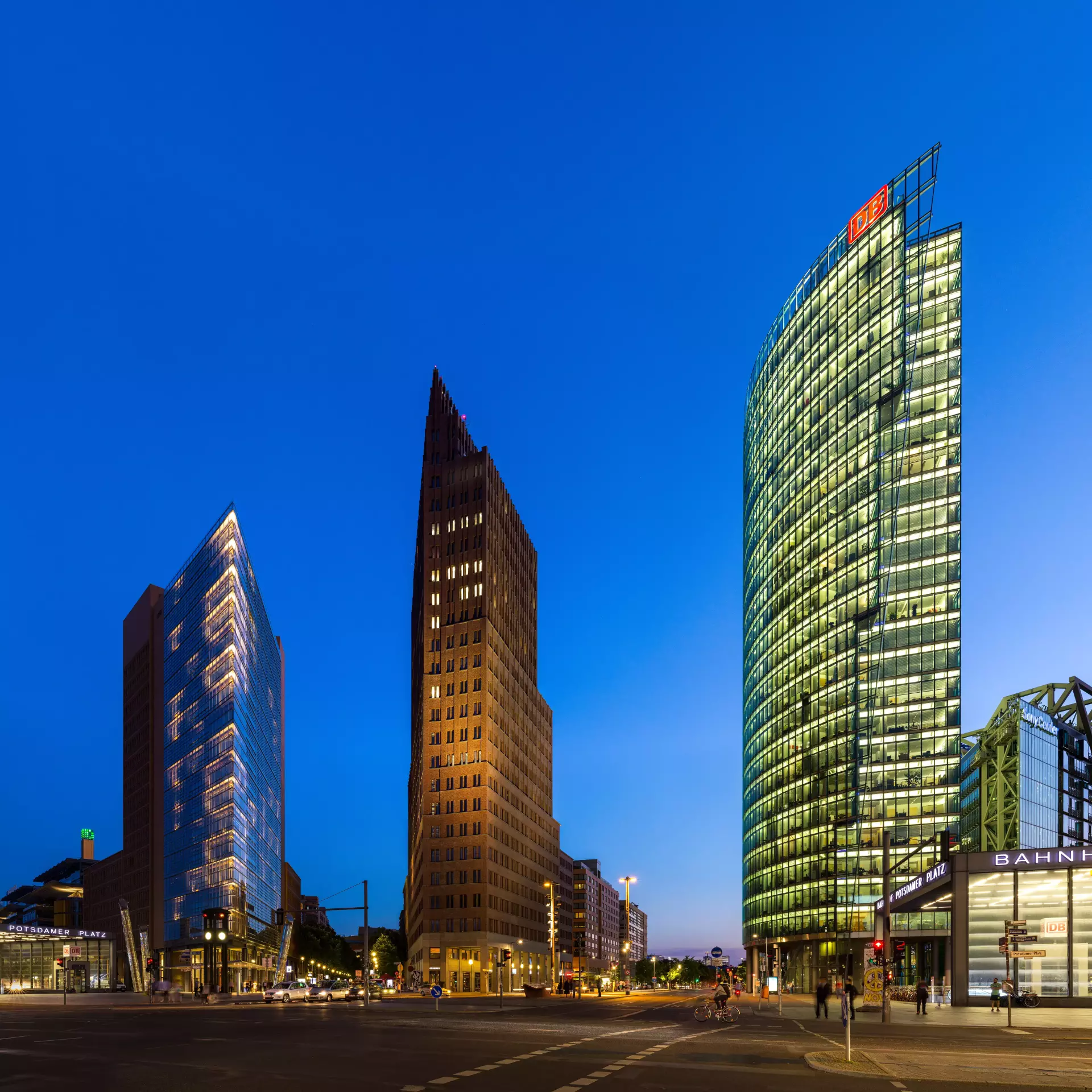
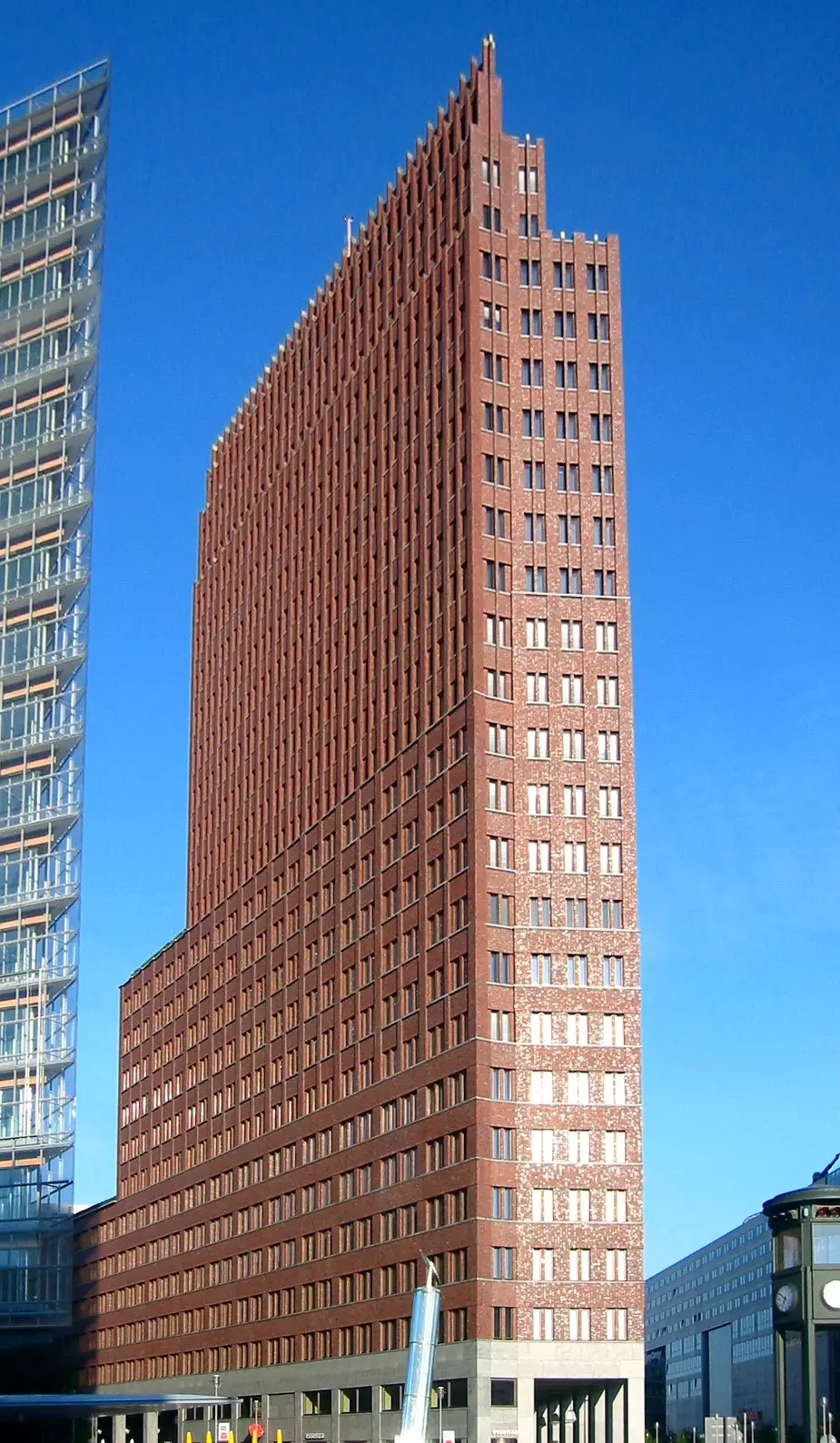
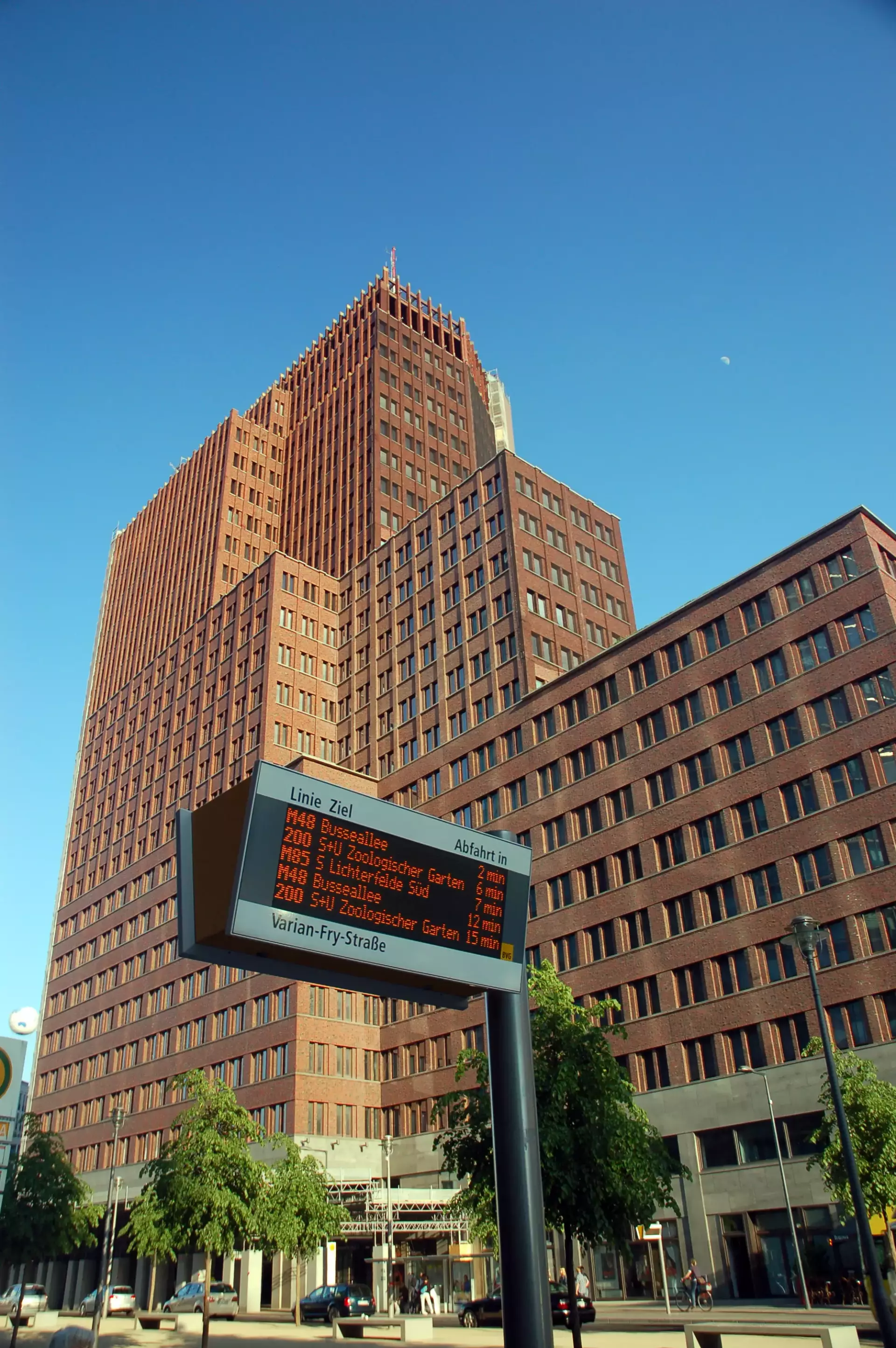
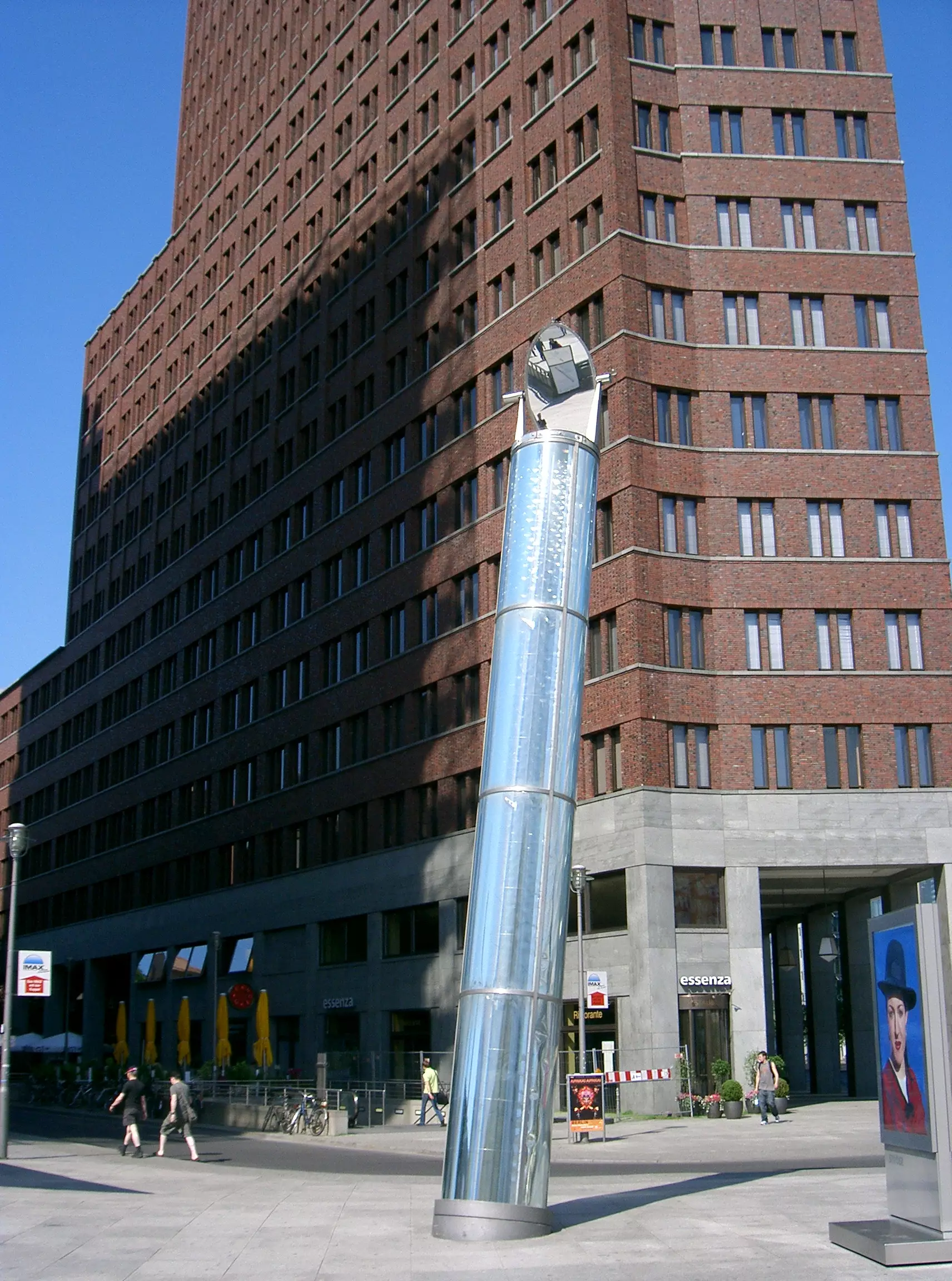
Kollhoff Tower stands on Potsdamer Platz in Berlin, a bold brick high‑rise that recalls classic skyscraper style while anchoring a modern city square. Designed by architect Hans Kollhoff and completed in 1999, the building blends stepped Art Deco lines with contemporary materials, creating a strong silhouette among glass and steel neighbors.
Panoramapunkt occupies the tower’s upper floors and rooftop. The viewing terrace sits 101 metres above ground, opening wide views across Berlin’s landmarks—from the Brandenburg Gate and Tiergarten to the TV Tower at Alexanderplatz. Clear panels and open-air corners let city sounds drift up, adding a sense of scale to the panorama.
Access is part of the experience: Europe’s fastest elevator carries visitors from the lobby to the 24th floor in seconds. The swift ascent becomes a brief, thrilling prelude to the skyline reveal at the top.
Potsdamer Platz was once a busy pre‑war crossroads, later a divided no‑man’s‑land during the Cold War, and today a symbol of reunification and urban renewal. From Panoramapunkt, this layered history becomes visible at a glance. Informational displays trace the square’s transformation, while outdoor plaques align sightlines with key buildings and districts.
The tower’s reddish brick facade is articulated with deep window bays and vertical ribs, giving texture that changes with shifting light. At street level, cafes, shops, and cinema crowds underscore the square’s steady energy. Above, the terrace offers a calmer perch, where trains glide into the nearby station and traffic lines the boulevards below, sketching the daily rhythm of the city.
Source - https://en.wikipedia.org/wiki/Kollhoff-Tower
Closed for renovations; the temporary Bauhaus-Archiv is at Knesebeckstraße 1-2 in Charlottenburg. Building designed by Walter Gropius. Inside a museum, library, cafe and shop.
Germany's national centre for contemporary non-European art. The house is a leading centre for the contemporary arts and a venue for projects breaking through artistic boundaries. This architectural landmark was an American contribution to the international building exhibition INTERBAU 1957 as an embodiment of the free exchange of ideas. Colloquially called Schwangere Auster (Pregnant Oyster).
Built 1859-1866 this is one of the most architecturally stunning synagogues in Germany to survive both the Nazi era and the war.
The oldest museum of its kind in Germany which, despite great losses during the World War II, still possesses one of the world's primary collections of European applied art. There are two sections to the collection: one located at the Kulturforum in Tiergarten, the other at Köpenick Palace.
This heritage-protected 120-m-long pedestrian tunnel below the river Spree was the first ferro-concrete tunnel in Germany that has been built using pneumatic caissons. Two beaches can be accessed via the tunnel which are not far from its south entrance.
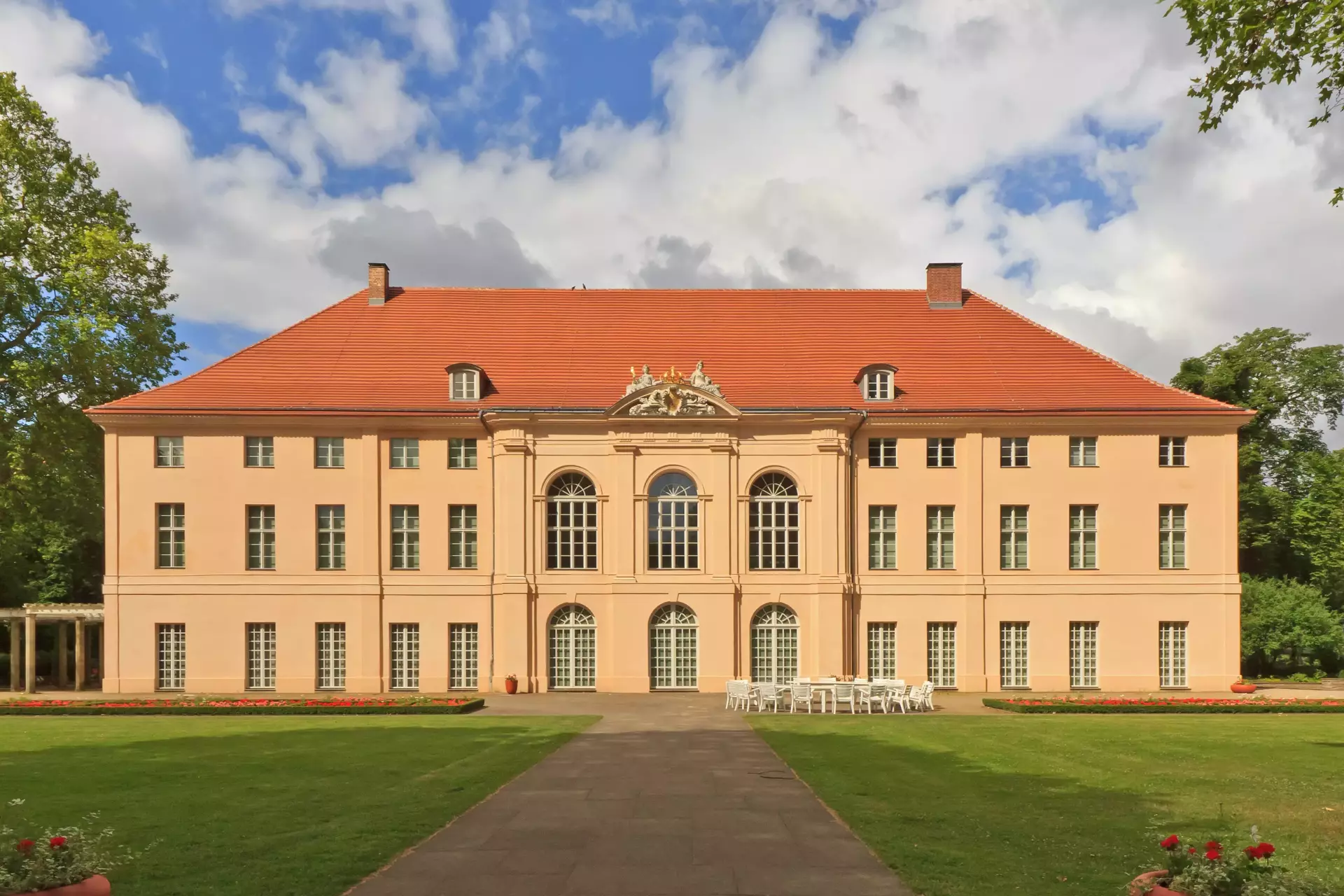
The charming Baroque water palace of the Hohenzollern electors surrounded by the Dahme river and an English garden.
An eerie memorial to victims of the Nazi regime built on the place of a former execution room, where nearly 2900 people where put to death between 1933 and 1945.
Berlin's oldest church (1230) is a 3-nave hall church. It is in the centre of an area destroyed by bombs in the war which was then turned into a faux "old town" by the East German authorities called Nikolaiviertel. The area is more a hodge-podge of relocated buildings than an authentic reproduction, and the newly-built 1988 apartments that attempt to "harmonize" with the older buildings are embarrassing. The church is one of the only structures that was renovated rather than rebuilt. It is best known for a sandstone sculpture called the Spandauer Madonna (1290), but there are other interesting pieces here. When the church was destroyed in 1938 and rebuilt in the 1970s, the communist officials intended to use it as a museum, which did not open until 1987. The museum includes sacred textiles and religious sculpture from the fourteenth to the sixteenth centuries. The Nikolaikirche is the showplace of the Nikolaiviertel, which isn't saying much.
Built by Hitler for the 1936 Olympic Games, this is one of the better examples of Nazi neoclassical architecture (laying claim to the legacy of Rome, fasces and all) and is still used for sporting events. At those Olympics, African-American athlete Jesse Owens won four gold medals, a party-spoiler for Aryan superiority. It's the home of soccer team Hertha BSC - they were relegated in 2023 and now play in 2. Bundesliga the second tier. In 2024 this stadium hosted games in the UEFA Euro Finals, including the final itself. For a glimpse of the Olympiastadion in its original state, seek out Leni Riefenstahl's movie Olympia - clips are shown in the Kinemathek and elsewhere.
This outdoor and indoor history museum documents the terror applied by the Nazi regime. It is on the site of buildings which during the Nazi regime from 1933 to 1945 were the headquarters of the Gestapo and the SS, the principal instruments of repression during the Nazi era.
A small castle in late classical style. It was built 1868 by Martin Gropius (uncle of the Bauhaus-founder and other architects, the von Siemens family changed the castle a bit around 1900 and they enlarged the dimensions of the park, which is today renovated and nice to wander around when the sun is shining. Located within a few minutes' walking distance from Biesdorf station (take the S5 from the city centre) or Elsterwerdaer Platz station (U5).
An observation tower without an elevator in Southeast Berlin, from which you can see that there is a great deal of forest around Berlin. There is a cafe at the tower.
This heritage-protected public bathing beach which opened in 1907 is one of the largest inland lidos in Europe and has a 1275-m-long sand beach, a capacity for up to 30,000 guests and a popular nudist area.
Want to feel like one of the angels in Wim Wenders' classic film Der Himmel über Berlin (a.k.a. Wings of Desire)? Climb to the top of Gold-Else, as the statue of Victory on the top of the Victory Column is known. Just don't jump off if you're not actually an angel. Unfortunately there is no elevator, so be prepared for 285 steps to the platform at 50.7 m.Else was built to commemorate Prussian military prowess in the wars against Denmark (1864), Austria (1866) and France (1870-71), and moved to her present location by the Nazis. Five roads run into a traffic circle called Grosser Stern, in the centre of which is the Siegessäule. Else is visible from much of the city district known as Tiergarten. At the base of the statue are reliefs of war scenes representing the conflicts which this monument memorializes. The Allies forced Germany to take those panels down in 1945, but they were remounted in 1984 and 1987. It also served as a backdrop for a speech by then senator Obama in 2008, after his request to speak in front of Brandenburger Tor caused a political debate in Germany.
The district town hall was the main town hall for West Berlin during the Cold War. The freedom bell (a present from the American people) and several memorials from that time can be found here. On the main balcony in 1963 U.S. President John F. Kennedy made his famous statement, "All free men, wherever they may live, are citizens of Berlin, and, therefore, as a free man, I take pride in the words ‘Ich bin ein Berliner!’". On 10 November 1989 Helmut Kohl (chancellor (Bundeskanzler) 1982-1998) and Willy Brandt (former Bundeskanzler and mayor of Berlin) cheering the crowd as they saw the end of the Berlin Wall the night before. The town hall is an emotional place for most people in Berlin (especially West Berlin).
The longest moving refracting telescope is 21 m long with a lens diameter of 68 cm. This giant telescope was built in 1896 by Dr. Freidrich Simon Archenhold but is now part of the Deutsches Technikmuseum Berlin. It was the place where Albert Einstein presented his Theory of Relativity to the public in 1915.
Features many objects and even whole rooms in Wilhelminian style. Only accessible by guided tour (English tours can be arranged).