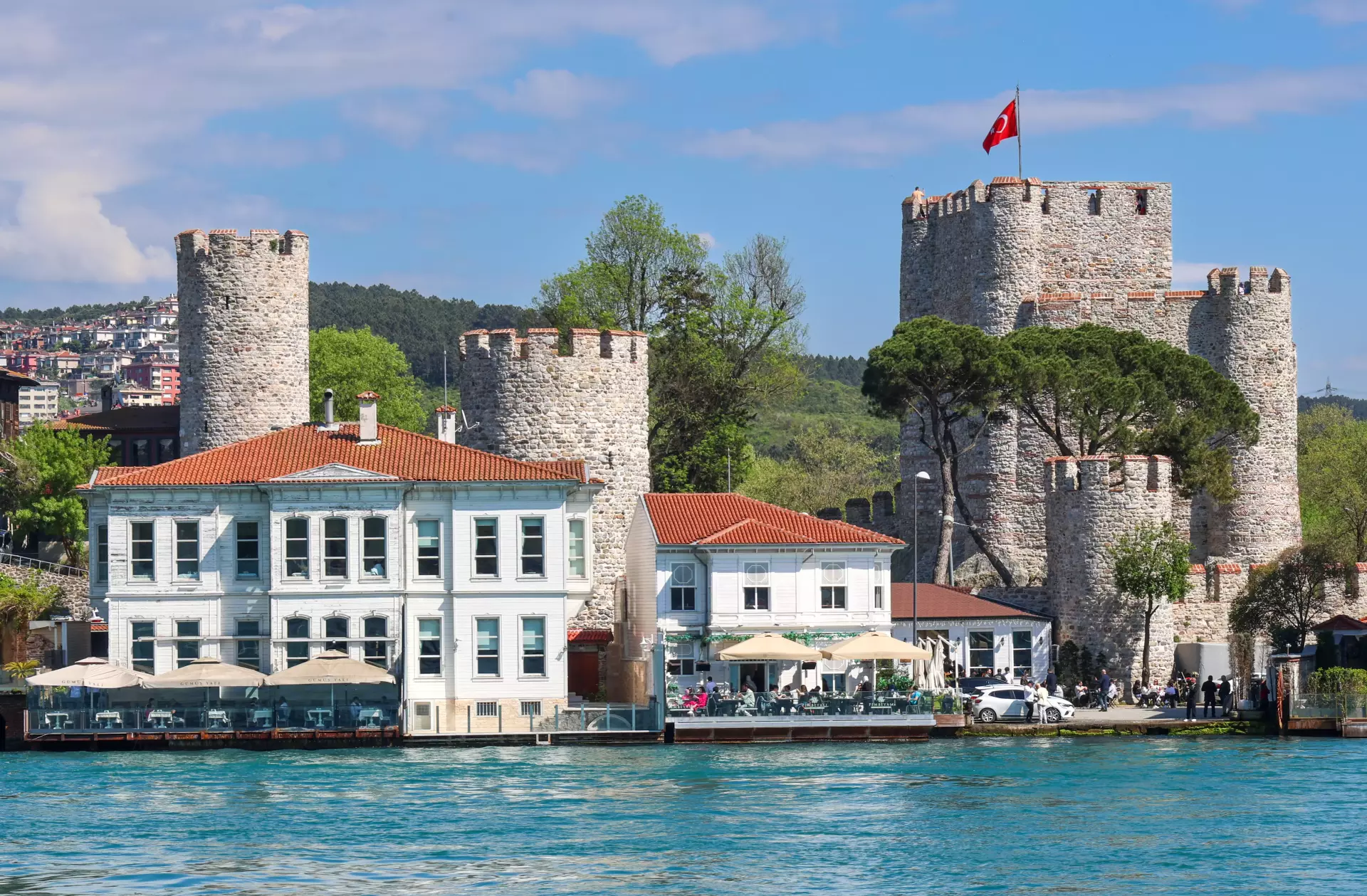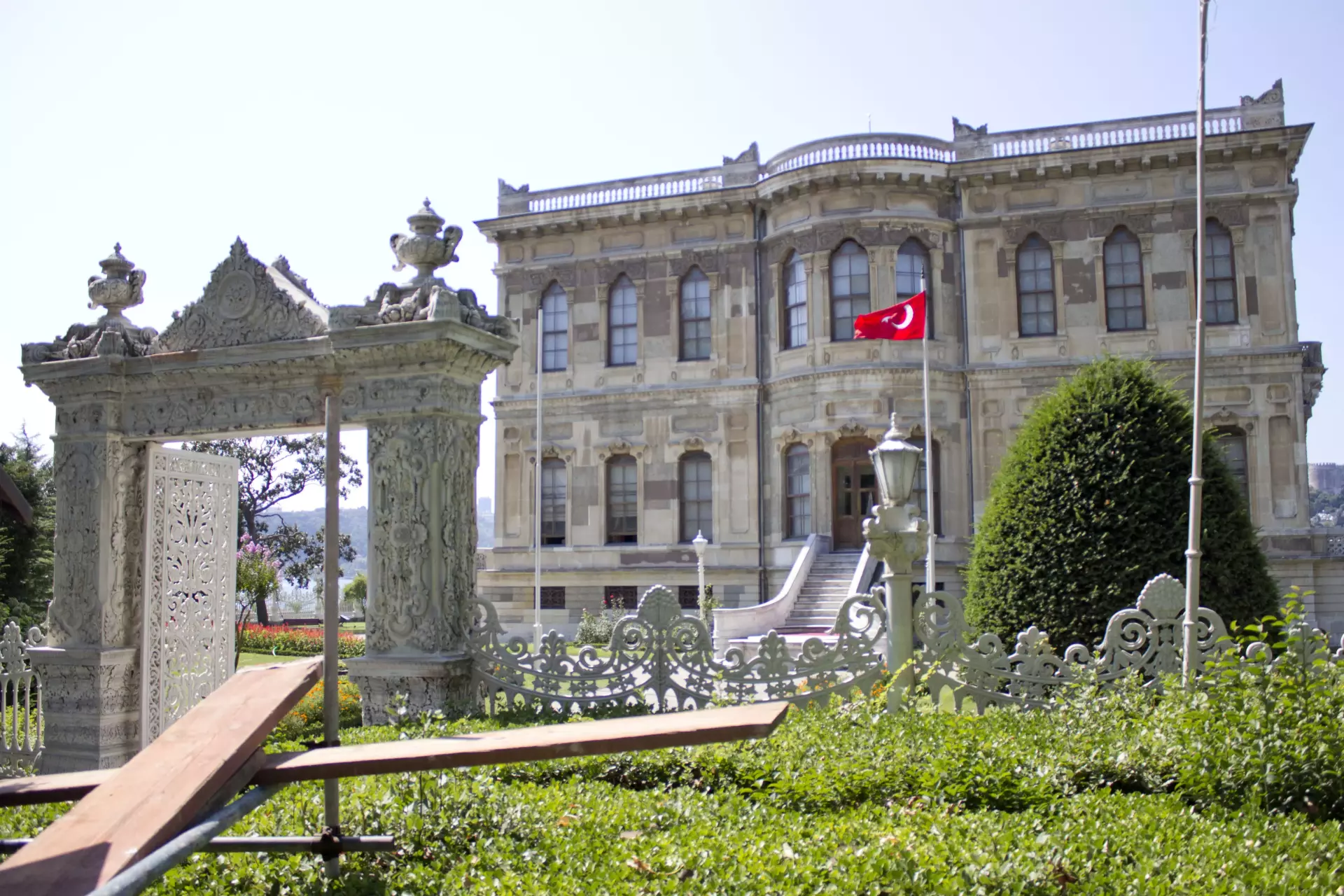
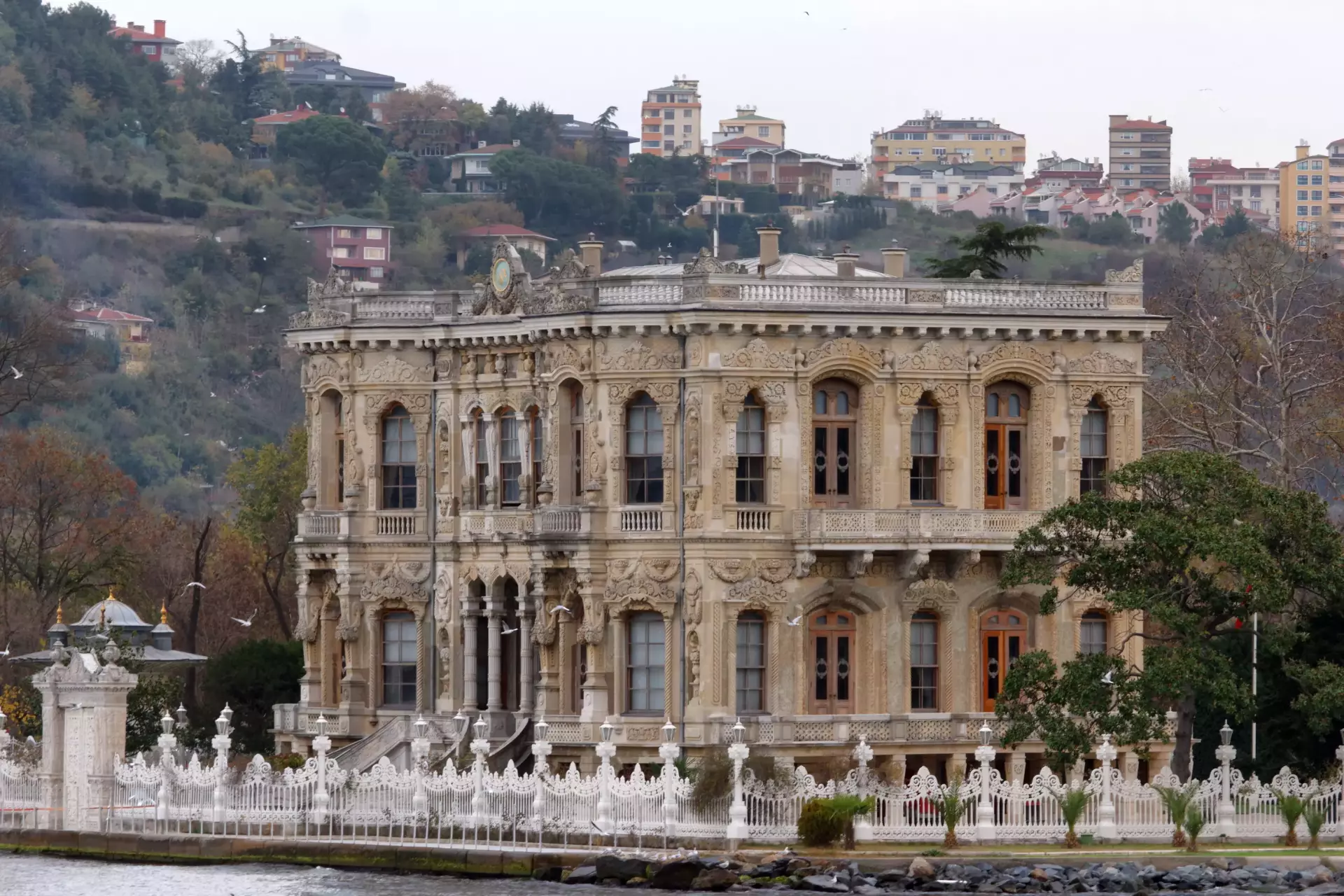
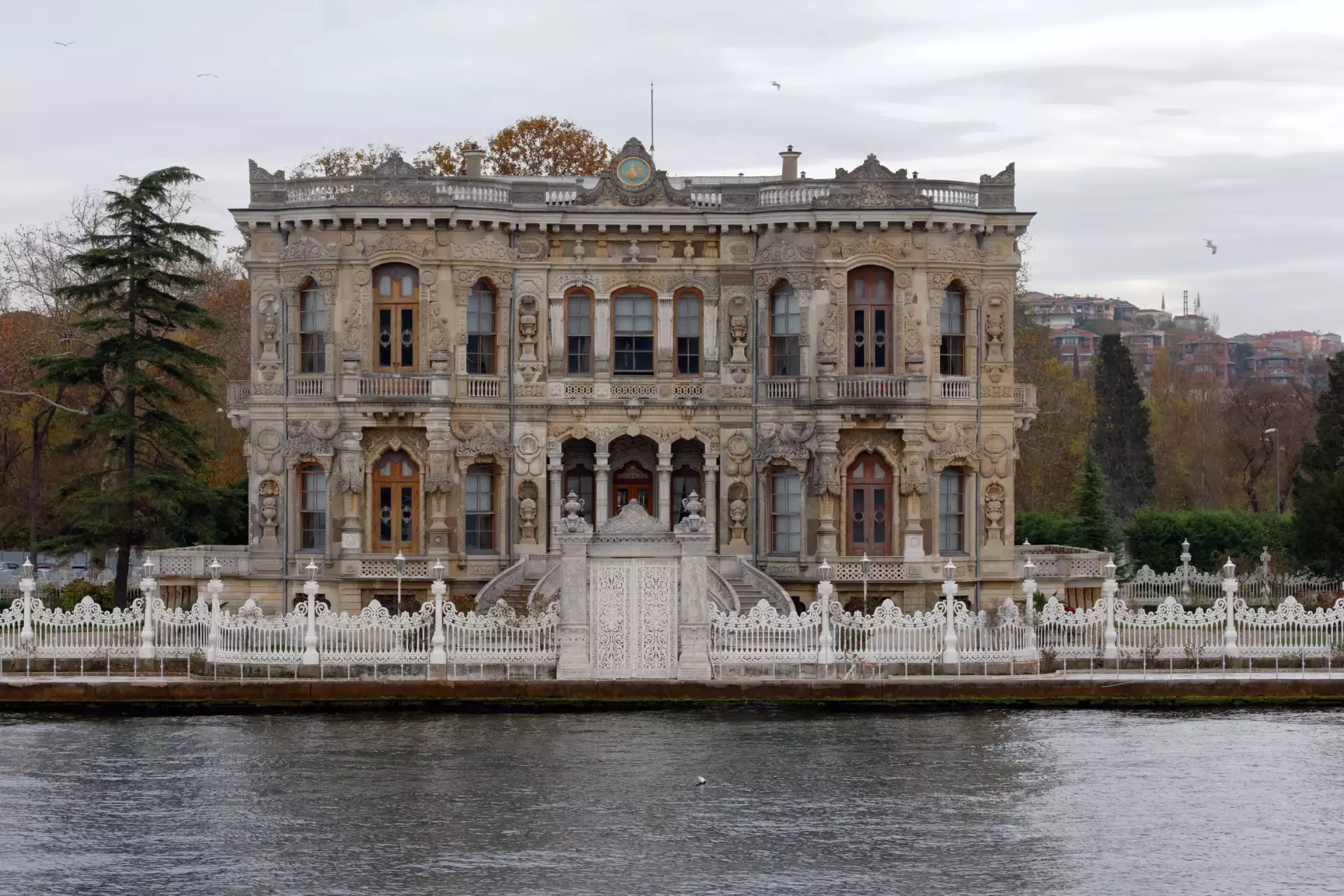
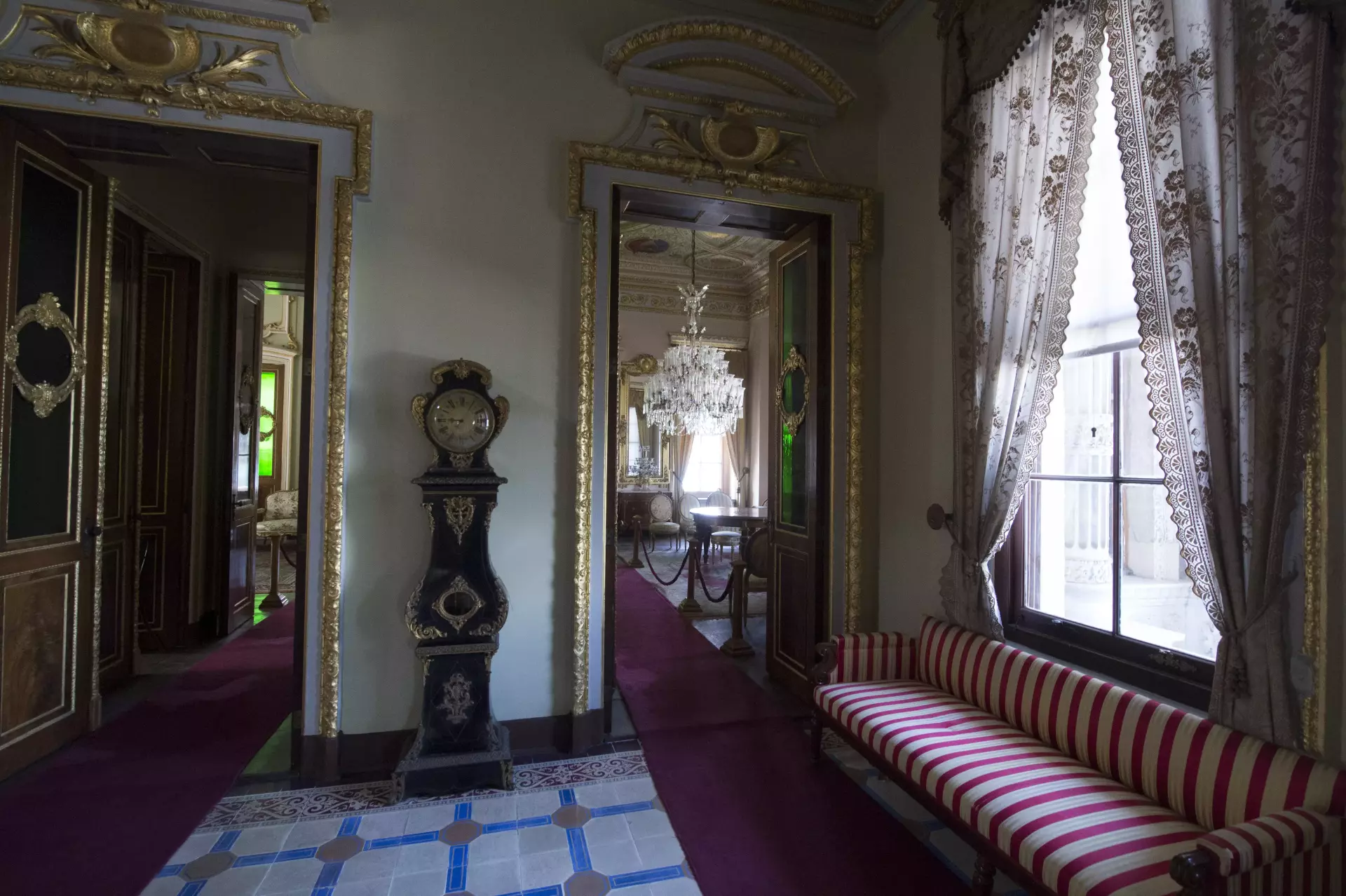
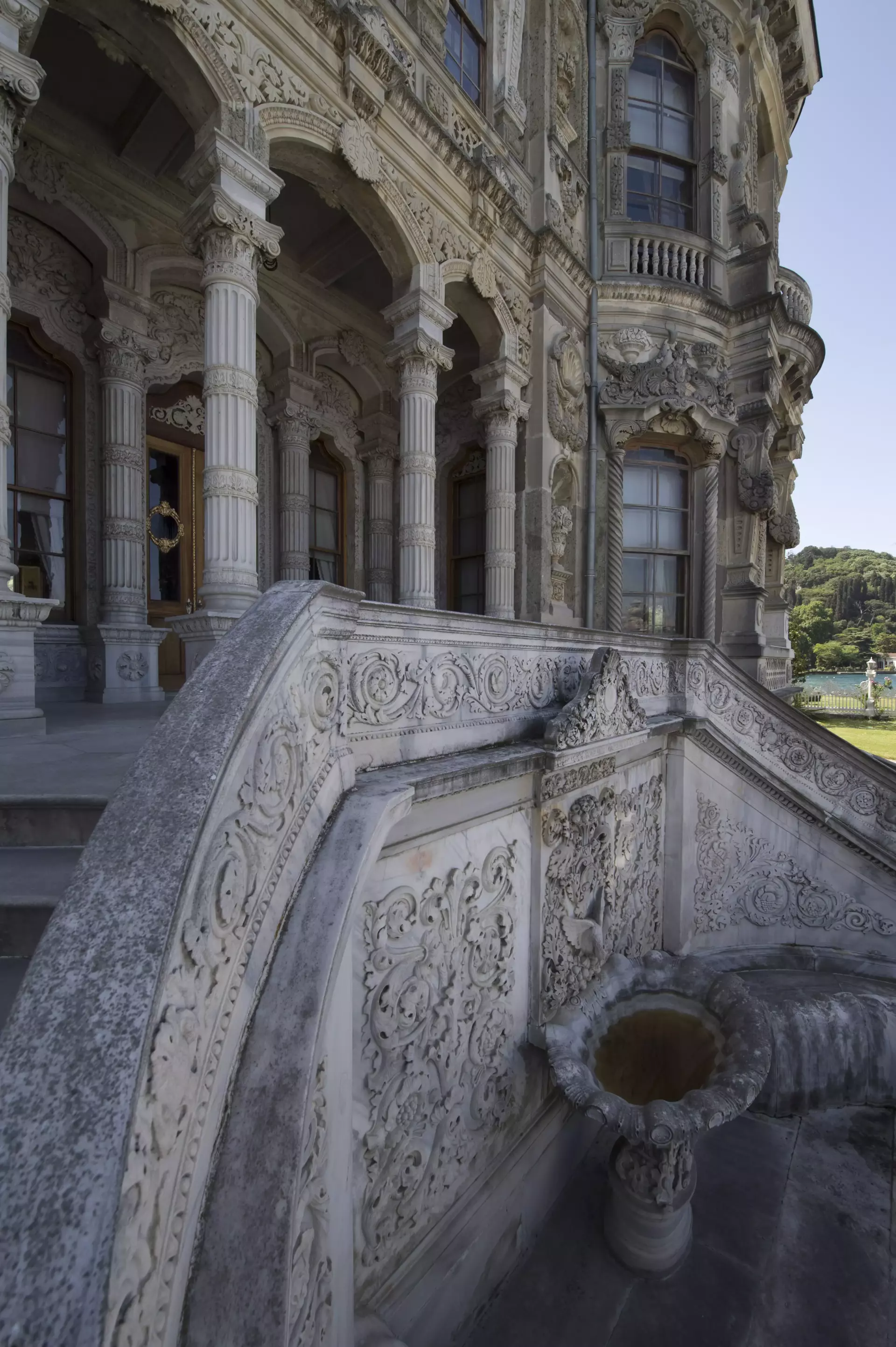
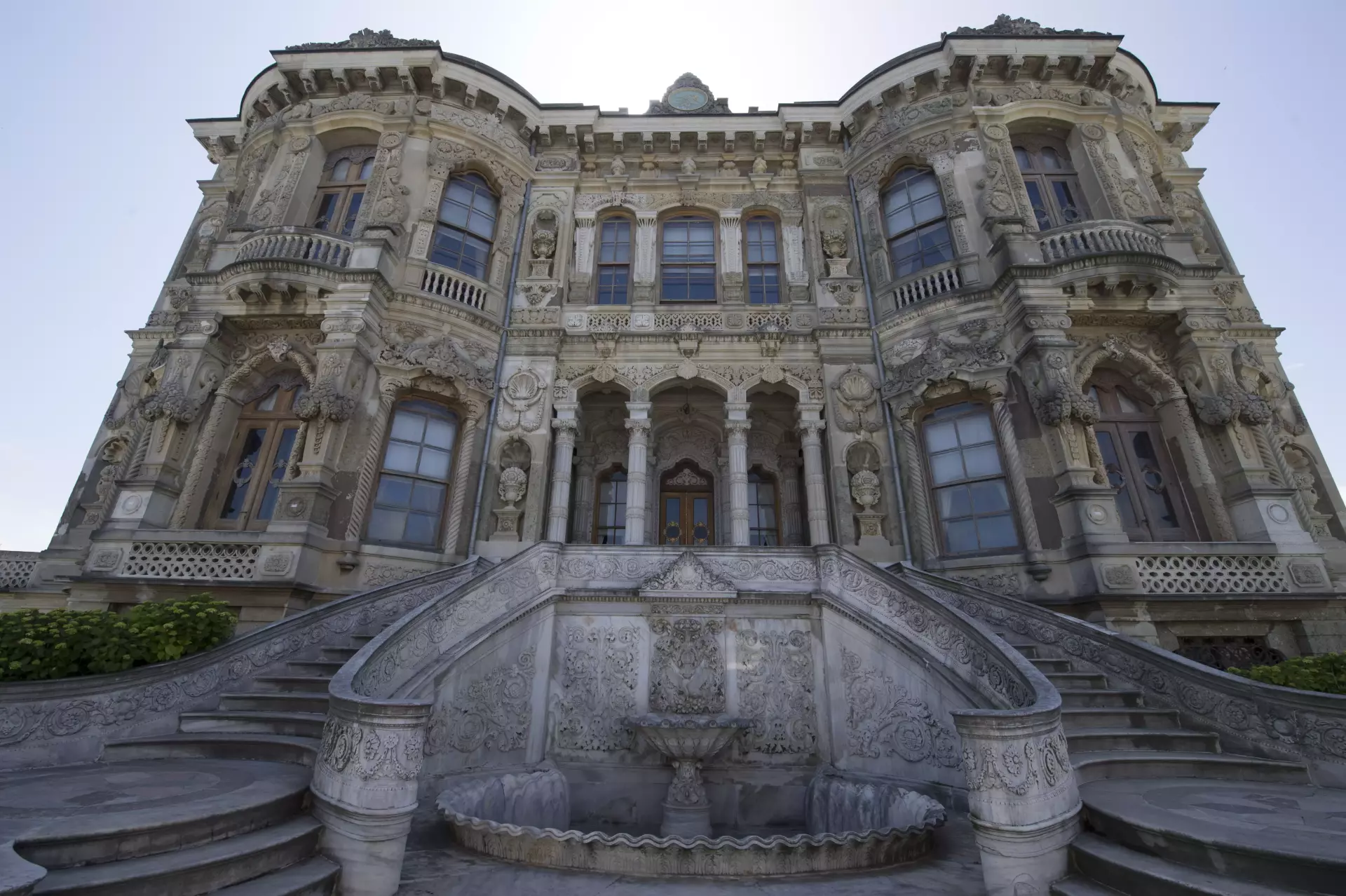
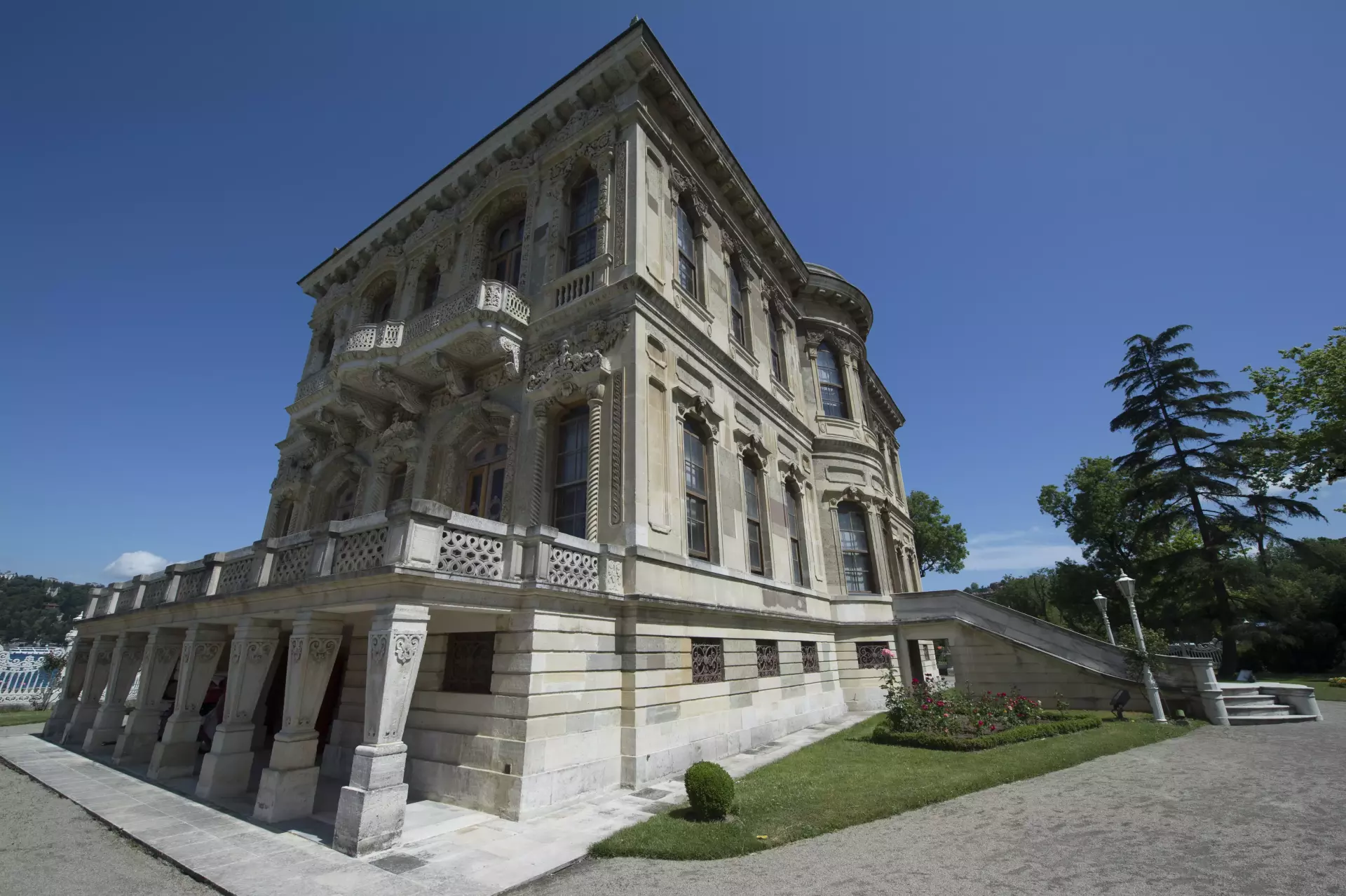
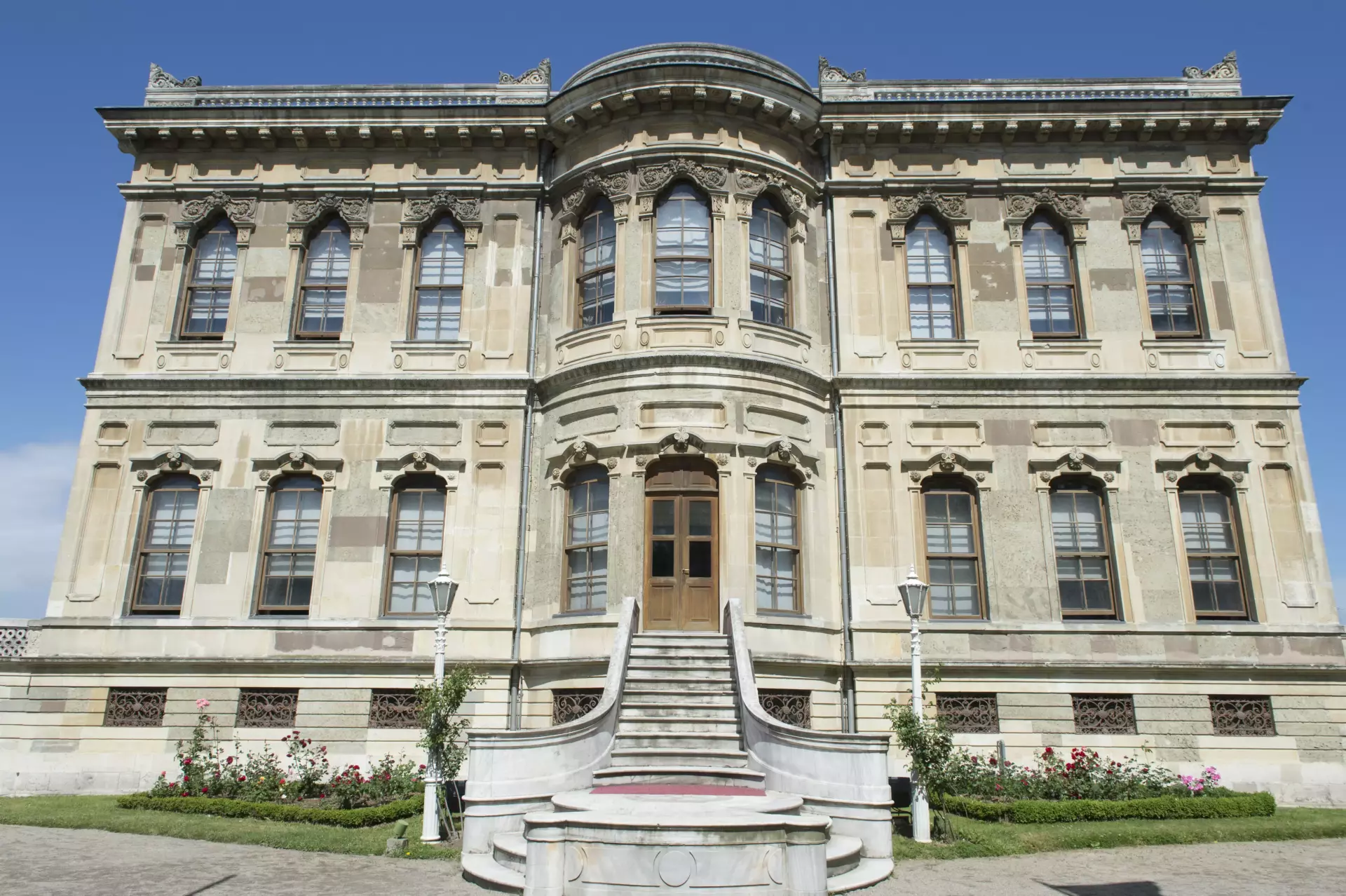
Küçüksu Palace is a striking neo-Baroque manor that stands on the banks where the Göksu River meets the Bosphorus. This elegant palace dates back to the 19th century and once served as a countryside retreat and hunting lodge for members of the Ottoman dynasty. Its picturesque setting and ornate architecture reflect the grandeur of its era.
The surrounding area gained fame among early European travelers, who referred to it as "the Sweet Waters of Asia." This name set it apart from a similar retreat area on the opposite side of the city, called "the Sweet Waters of Europe," where the Kağıthane and Alibeyköy Rivers flow into the Golden Horn. Both regions were popular recreational spots for the city’s elite, offering lush scenery and a peaceful escape from urban life.
Source - https://en.wikipedia.org/wiki/K%C3%BC%C3%A7%C3%BCksu_Pavilion
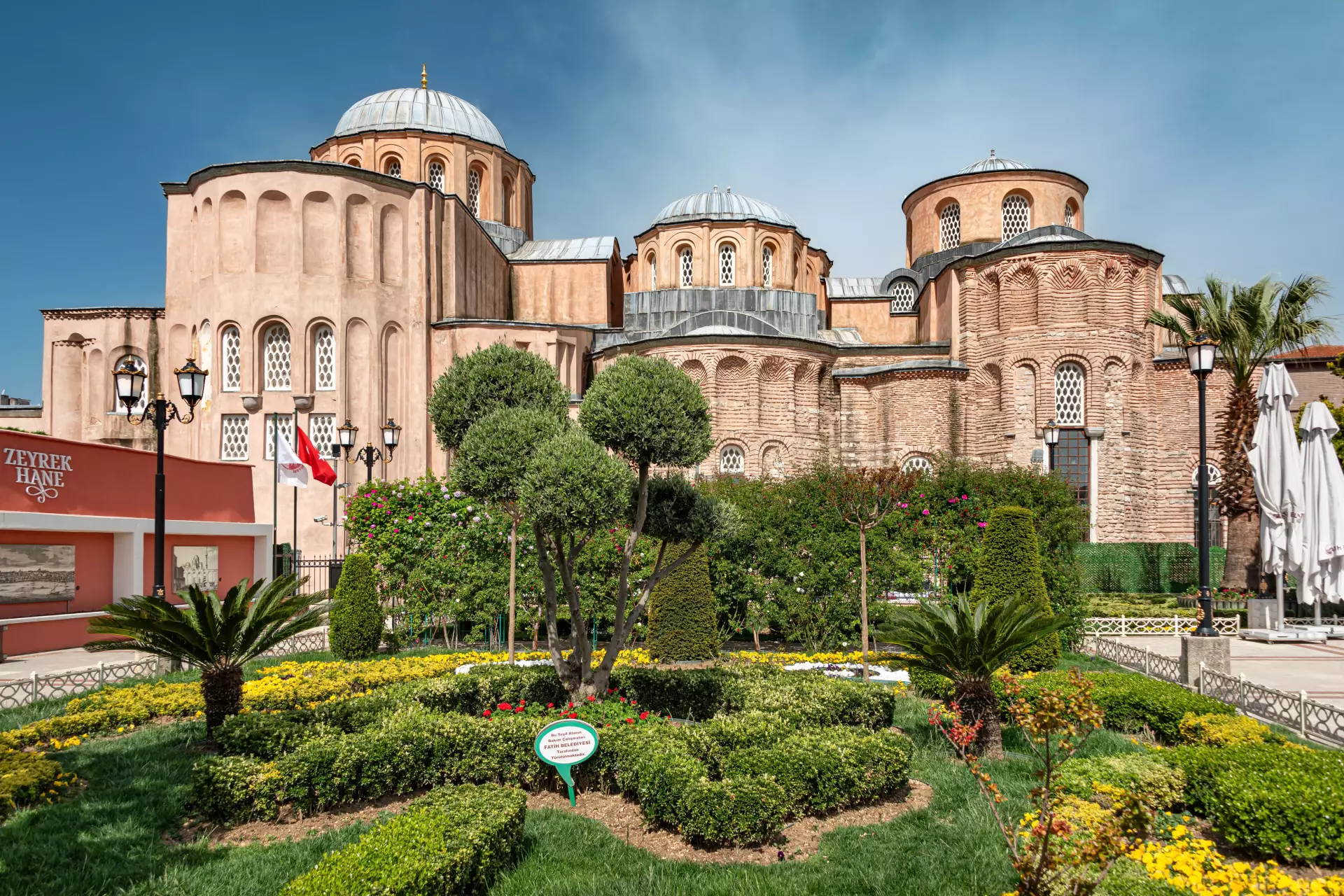
The Golden Gate was the ceremonial entrance through the Theodosian city walls. After the Ottomans captured the city in 1453, Mehmed II needed a stronghold for his treasures and documents. The gate was therefore bricked up and the walls reinforced into a fortress, with valuables stored in its seven towers, hence yedi kule. In the following century the treasury moved to Topkapi Palace and the fort became a prison for high-level detainees - Osman II was strangled here in 1622. It remained in use until 1837, whereupon the Golden Gate was re-opened.
Chora means countryside, and when built as a monastery in the 4th century it stood outside the Constantine walls; a century later, it was incorporated into the Theodosian walls. It was rebuilt in the 11th century then wrecked by an earthquake, so the structure and fabulous mosaics you see now are 14th century. When the church was converted to a mosque in 1500 the mosaics were plastered over, and only restored in 1958 when it became a museum. In 2020 it was again proclaimed a mosque but here (unlike Fethiye Mosque) they saw the sense and tourist income of preserving the mosaics. You need to work around prayer times.
Built in the early 5th century as a monastery dedicated to Saint Andrew the Apostle, in 766 it was the burial place of Saint Andrew of Crete and was later re-dedicated to him. It was rebuilt in the late 9th century and again in the 13th, then around 1490 converted into a mosque. From the 16th century it was occupied by the Dervishes, when the legend arose that a chain hung to a cypress tree in the courtyard was a truth diviner. The chain was swung between rival witnesses and the one it hit was telling the truth. The cypress stump is still standing.
Built in 1564 by Mimar Sinan for Rüstem Pasha, Grand Vizier of Suleiman the Magnificent, this small mosque has an interior covered by beautiful Iznik pottery, then at its zenith.
A neighbourhood east of Şişli known for its Art Nouveau apartment buildings, the ground floors of many of which are upmarket restaurants, cafes, pubs, and garment stores lining the sidewalks. Nobel laureate Orhan Pamuk, well-known Turkish novelist, is a lifelong resident of the neighbourhood which formed the background of several of his novels.
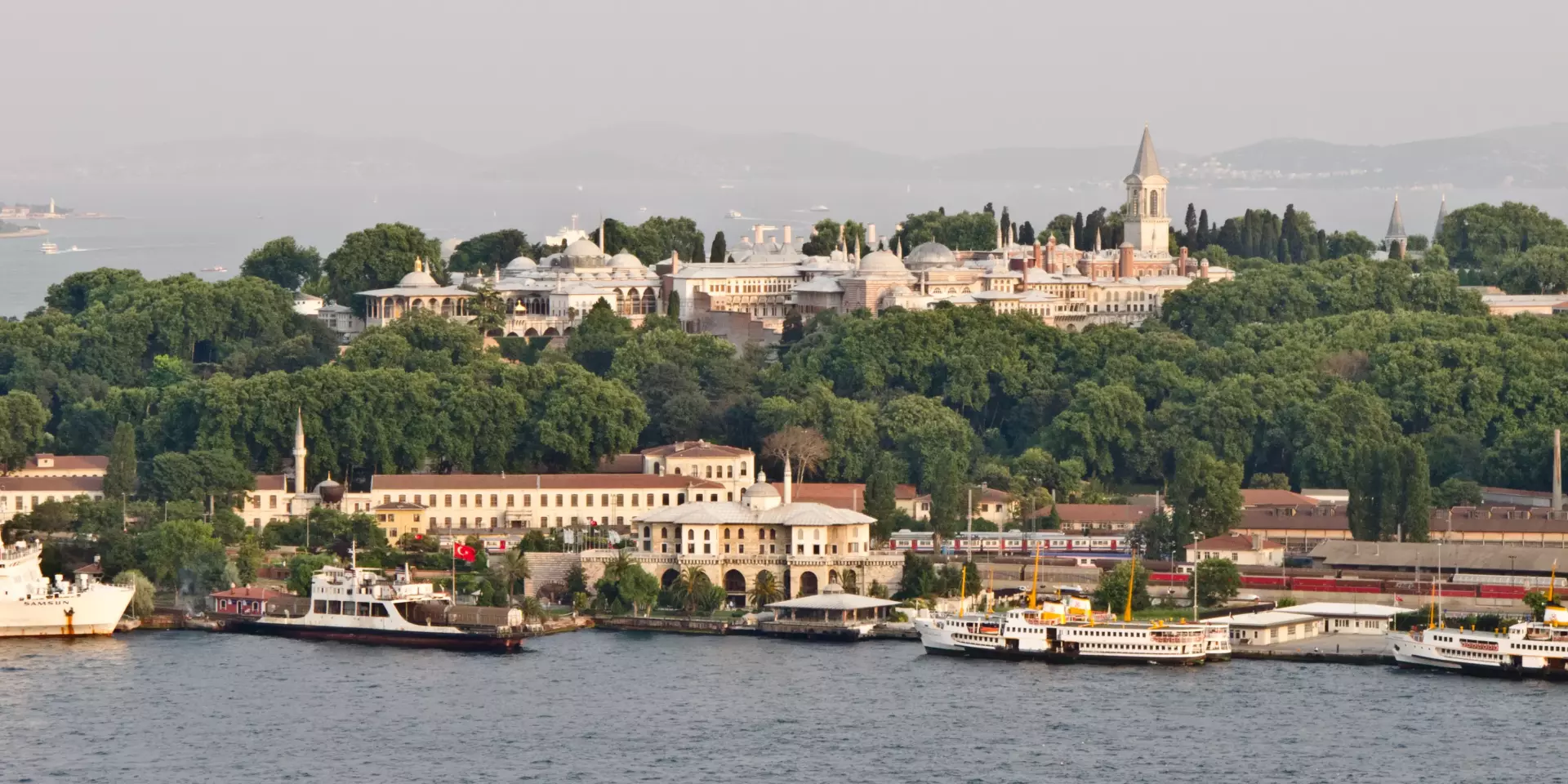
The imperial enclave of the Ottoman emperors for four centuries. Lavishly decorated, with exhibitions of fine craftmanship and four courts of increasing grandeur. The second court has the Harem and the State Treasury, housing a weaponry display. The third court has the Imperial Treasury, with Islamic and Christian relics. The views from the Fourth Court over the Bosphorus are spectacular. Reckon on spending several hours here and bring water as the museum kiosk is overpriced.
On top of a hill overlooking the Golden Horn, this is a magnificent mosque built by Sinan in the 1550s. It was centrepiece of a large külliye, a religious complex which included madrasas, a public kitchen and a hospital.. The small cemetery east has the mausoleums of Suleiman the Magnificent and of his wife Hurrem Sultan or Roxelana.
Situated on the gentle hill overlooking the neighbourhood of Emirgan and the Bosphorus, Emirgan Park was for long the only place in the city where Istanbulites can admire the beauty of tulips. Having lost that distinction since the first decade of the 2000s as tulips are now everywhere, this is still a beautiful park with artificial ponds, small waterfalls, and impressive views of the Bosphorus. There are also cafes with open-air sections housed in pleasant former imperial hunting manors. Squirrels are there, too, in the middle of this metropolis of more than 15 million people, though you may have to look a bit deeper (or a bit upper on the branches!) to spot them.
The avenue has little in common with Baghdad, except it was the beginning of the Ottoman-era route to that city followed by many, including Ottoman sultan Murat IV during his march upon Persia, after which he captured Baghdad. In fact, with its sidewalk cafés and Western restaurants, Bağdat Caddesi is usually considered as one of Istanbul's most western-flavoured streets, ironically located in Asia. This street is not completely pedestrianized unlike Istiklal Street, which serves a similar function on the European Side, but its broad sidewalks with tree shade offer a pleasant walk. The restaurants and cafés on the avenue are mainly upscale, but there are also some quite affordable ones scattered around occasionally. Shopping opportunities also abound. From Kadıköy, take the Bostancı-bound dolmuşes (from just south of the ferries) or the public bus #4 (its stop is near the one for the dolmuş, but separate).
The original mosque was built between 1463-1470 by the Greek architect Atik Sinan, by order of Sultan Mehmet II the Conqueror, on the site of the former Church of the Holy Apostles, which had served as Byzantine Imperial burial place for a thousand years. The grand complex with eight medreses, a library, hospital, hospice, caravanserai, market, hamam, primary school and public soup kitchen was smashed again and again by earthquakes, and the present building is from 1771 to a different design. The interior is lavish, and outside is the ornate tomb of Mehmet II and his wife Gülbahar Hatun.
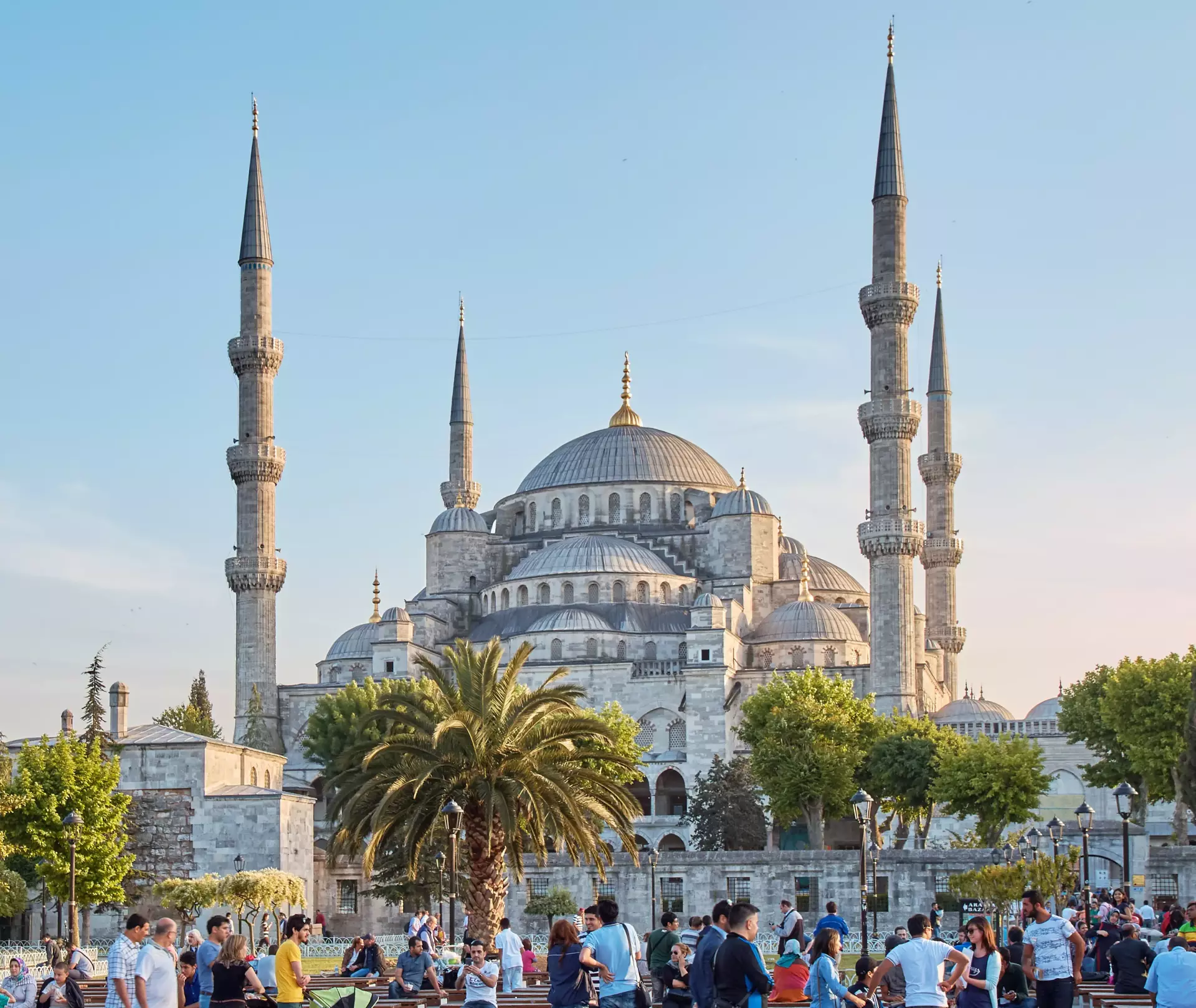
The defining image of Istanbul, dominating the skyline with its great dome and six minarets. Completed in 1617 for Sultan Ahmed I, it's still a working mosque, so dress appropriately and avoid prayer times. Enter via the courtyard on the SW side. You step (shoeless) into the blue-tiled prayer hall beneath the main dome and its semi-domes. The mihrab is of finely carved marble, well-lit, and the minbar (pulpit) next to it is visible from almost all parts.
Named after a 16th-century village, founded by Serbs deported from Belgrade when it fell to the Ottomans. The village was popular as a forest resort, but its inhabitants were resettled in the 19th century and it's now a bosky ruin. The forest is mostly primordial and deciduous, predominantly oak. It's dotted with ancient aqueducts and dams as this area was a water catchment for Constantinople / Istanbul, and has lots of walking jogging and cycling trails and picnic areas. The two main ways in are via Bahçeköy (near the Arboretum entrance) and Kemerburgaz (which has the best aqueducts). There's a small access toll. The forest is supposedly a protected area but is being encroached on by highways and suburbs: this is likely to get worse as the access route to Istanbul's new airport leads right through it.
This is a 1927 Beaux Arts building named after its patron Süreyya İlmen Pasha, then a deputy of Istanbul who was impressed by theatres in Europe during his visits. It became the first opera house in the Asian side of Istanbul, but due to deficiencies in its interior design, it barely staged any opera and was converted to a cinema soon afterwards. It underwent a significant restoration and reverted to its original purpose in 2007, so now houses performances of ballet, opera, and classical music; good tickets are often extremely cheap.
Although not at the size of Hagia Sophia, this is the largest active church in Turkey. It’s directly on Istiklal St, but somewhat hidden from view by its yard portal. Catholic Masses in Italian, Turkish, and English (in different days of the week).
A historic house museum dedicated to the life of Adam Mickiewicz, renowned Polish poet. This is where he lived while in Turkey from September 1855 to 26 November 1855, when he died of illness.
The Byzantines built several great palaces in Constantinople and this is the only one to survive almost intact. It's from the late 13th century, in typical alternating marble and red-brick rows, and was an imperial residence: Porphyrogenitus means "born to the purple" indicating the heir to the crown. Yet it was merely an annex or pavilion within the much greater Palace of Blachernae, of which nothing else remains. It's set within the north end of the Theodosian Walls and was much bashed during the Ottoman capture. Later it was variously a menagerie, brothel, pottery, poorhouse and bottle works, then fell derelict in the 20th century. In 2021 it re-opened as a museum.
A private museum with a large painting collection and archaeological collections of measurement units and tools used in Asia Minor since antiquity and faiences of Kütahya.
Among the exhibition of this museum are five thousand pieces from the Ottoman era through WWII, with the most prominent piece possibly being the huge chain that the Byzantines stretched across the mouth of the Golden Horn to keep out the Sultan's navy in 1453 during the siege of Constantinople. In the yard of the museum, the Janissary Band (Mehter Takımı), the world’s oldest military band gives concerts of march music in traditional uniforms each afternoon, at 15:00.